(Photo: NASA/JPL-Caltech/University of Arizona)
Harvard astrophysicist Avi Loeb's warning that the interstellar object 3I/ATLAS may be pulling a "swarm" of unknown bodies through the Solar System has injected new urgency into the scientific debate over one of the strangest visitors astronomers have ever recorded. The object, first detected on July 1, 2025, has displayed a chemical profile, tail geometry and acceleration pattern that diverge sharply from the behaviour of any known natural comet, prompting speculation that the anomaly may reflect not just exotic physics but even alien technology.
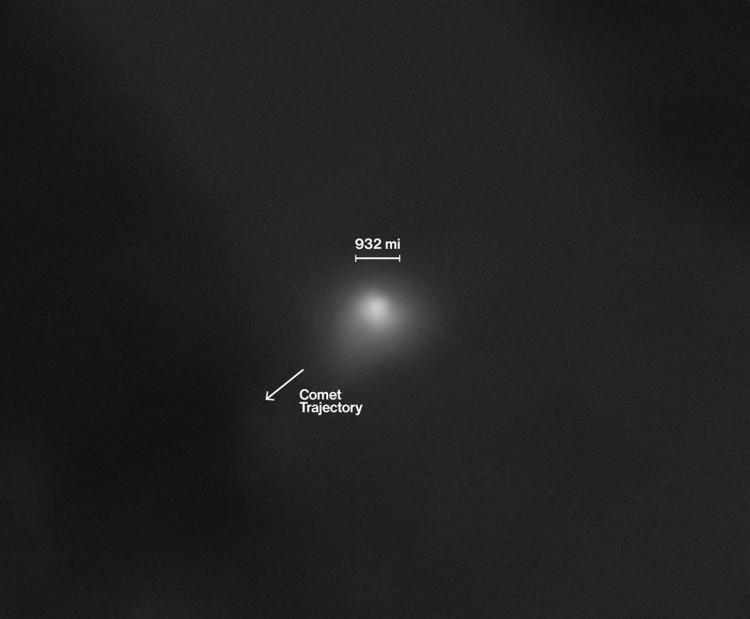
Early observations showed 3I/ATLAS moving through the inner Solar System with an unusual teardrop-shaped coma and a faint anti-solar tail, challenging expectations about how sunlight should interact with a sublimating body. The object's variability deepened with spectroscopic readings from the James Webb Space Telescope, which identified a coma dominated by carbon dioxide and an extreme CO₂/H₂O ratio. That concentration is typically associated with bodies formed far past their home system's snow line, where volatiles freeze and remain trapped for billions of years.
Additional spectrophotometric studies indicated the nucleus may be unusually strong and metal-rich, more reminiscent of carbonaceous chondrites than the fragile, dusty bodies common to Solar System comets. The combination of an underdeveloped tail, high CO₂ content and hints of a hardened, mineral-heavy nucleus has led astronomers to consider whether the object represents a class of interstellar material that has never previously been observed.
It is against this backdrop that Loeb has advanced his most controversial interpretation. The Harvard astrophysicist argues that the persistence and brightness of the Sun-facing glow on 3I/ATLAS - as well as its unexpected acceleration - "defy simple geometric explanations." He has suggested the possibility of a group of objects travelling in formation or a composite system rather than a solitary nucleus, and raised the hypothesis that the formation could include artificial components. That includes the provocative scenario in which 3I/ATLAS is a probe accompanied by smaller devices or natural fragments.
Standard explanations for an anti-tail - an optical illusion created when dust trails align with the observer's position relative to the comet's orbital plane - fall short, Loeb argues, because the phenomenon on 3I/ATLAS has remained too stable over time. The persistence of the glow, combined with inconsistent acceleration measurements, has pushed Loeb to call for deeper investigation into whether the patterns reflect deliberate, non-gravitational control rather than random ejection of dust and gas.
Mainstream scientists, while acknowledging 3I/ATLAS's oddities, have responded cautiously. A peer-reviewed preprint from August 2025 attributed the object's behaviour to its metal-rich composition and unusually large dust grains, which could delay tail formation and create its apparent asymmetry. The study argues that metal-ice sublimation could drive the coma morphology without invoking artificial mechanisms. Optical surveys from July to September also documented power-law dust behaviour as a function of distance from the Sun, broadly consistent with volatile-driven activity even if the timing and geometry differ from typical comets.
Still, the debate underscores the scientific stakes. If Loeb's "swarm" hypothesis proved correct, or if evidence emerged of artificial design, the discovery would rank among the most consequential in modern astronomy. Even a natural explanation would challenge prevailing comet models built almost exclusively from Solar System examples, suggesting that interstellar objects may behave in fundamentally different ways.