(Photo: NASA/Goddard/SwRI/JHU-APL)
A new theory from Harvard astrophysicist Avi Loeb has intensified debate surrounding interstellar object 3I/ATLAS, after he suggested the comet-like body may be accompanied by a swarm of unknown objects-an assertion that pushes the scientific controversy far beyond earlier discussions of its unusual trajectory and optical features. The object, discovered July 1, 2025, by the ATLAS telescope in Chile, is only the third confirmed interstellar visitor to the solar system and is travelling at roughly 61 kilometres per second, among the fastest speeds ever recorded for a comet.
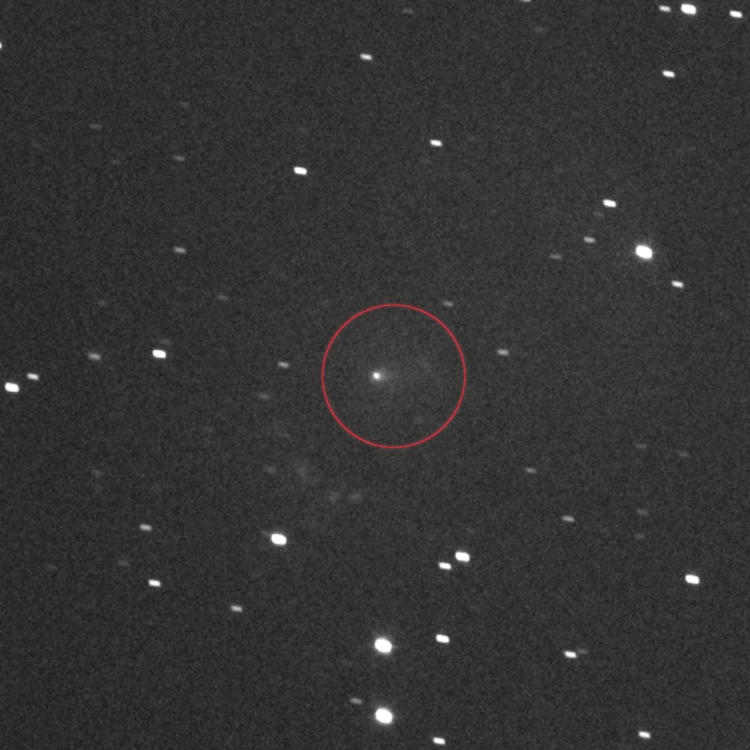
Scientists worldwide have been tracking 3I/ATLAS since its arrival due to a series of anomalies, including its hyperbolic orbit, unusual coma shape and the persistence of what Loeb describes as an "anti-tail," a glow seemingly pointing toward the Sun rather than away from it. Comet tails typically extend in the opposite direction of sunlight due to solar radiation and pressure. Images taken after the object's perihelion passage in November further deepened the puzzle, showing a teardrop-shaped forward-facing feature that contradicts conventional comet physics.
Loeb argues the anomaly might indicate that the structure is not a cometary tail at all but a cluster of separate bodies travelling in formation. He observed that the coma "did not behave as expected," prompting the hypothesis that the bright structure could originate from a collection of small objects reflecting sunlight rather than dust propelled backward by solar heating. In his post analyzing the images, Loeb asked directly: "Are they rocky fragments or something else?"
The theory diverges sharply from standard interpretations. Observations show that despite shedding gas and dust, 3I/ATLAS has exhibited little non-gravitational acceleration, implying a nucleus far more massive than initial estimates. Current calculations suggest a diameter between 0.3 and 5.6 kilometres-substantially larger than many first believed. If a swarm exists, its collective reflectivity could also explain why the object appears brighter and more structured than typical comets.
Speculation expanded further after Loeb previously floated the idea that the anti-tail could originate from a concentrated beam of light emitted by the object, which might be clearing particles from its path. The suggestion was rejected by most researchers but contributed to a growing catalogue of unconventional explanations as the scientific community searches for models that can account for the object's quirks.
NASA, however, maintains a more traditional interpretation. Agency scientists continue to classify 3I/ATLAS as a natural interstellar comet and recently reported potential evidence of ice volcanoes on its surface-features resembling cryovolcanic activity observed on distant solar system bodies beyond Neptune. Spectroscopic studies add further intrigue: 3I/ATLAS contains an unusually high carbon dioxide-to-water ratio, a signature that differs from most locally formed comets yet shows parallels to objects within our own system.
Even with the competing theories, the scientific uncertainty remains persistent. Researchers have yet to determine whether the optical effects result from debris, structural irregularities, or observational geometry. The unusual forward-facing glow has become a focal point of analysis, sparking new rounds of modelling as the object speeds away on its hyperbolic escape trajectory.