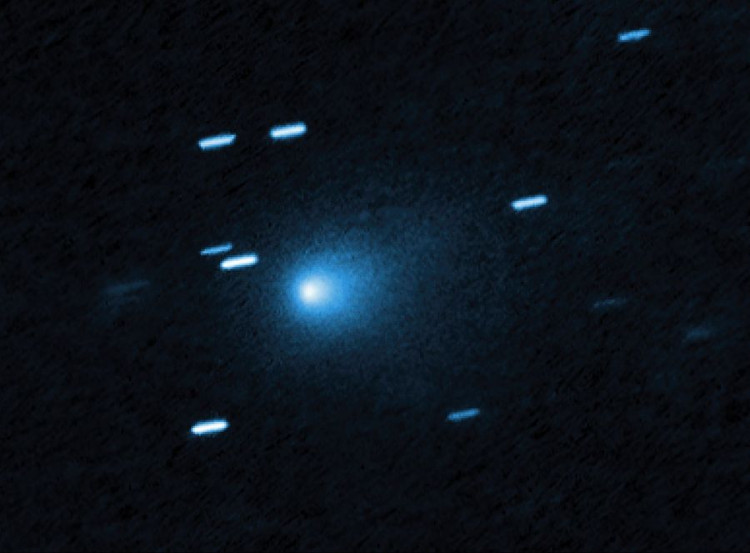
(Photo: NASA, ESA, David Jewitt (UCLA); Image Processing: Joseph DePasquale (STScI))
A rare interstellar encounter between the European Space Agency's Jupiter Icy Moons Explorer and the fast-moving comet 3I/ATLAS has given astronomers an early glimpse of what appears to be a highly active visitor from beyond the Solar System. The observation occurred as the comet passed near the spacecraft in November, offering researchers an unusual chance to capture data from only the third interstellar object ever recorded.
ESA engineers revealed that a partial download of "just a quarter of a single NavCam image" showed the comet bright and "surrounded by signs of activity," prompting anticipation for the full dataset, which will not begin arriving until February 2026. The decision to pull the small fragment came as scientists looked for confirmation that 3I/ATLAS was shedding material after its close approach to the Sun on 29 October.
Juice, launched in 2023 and en route to Jupiter for a 2031 arrival, was able to observe the object for brief intervals despite constraints on instrument exposure and spacecraft positioning. Its science package-JANUS, MAJIS, UVS, SWI and PEP-recorded data during a window that coincided with the comet's most volatile phase. At closest approach on 4 November, the spacecraft was roughly 66 million km from the comet.
3I/ATLAS was first identified by the ATLAS telescope network in July 2025. Its sharply hyperbolic orbit, with estimated eccentricity of 6.139, confirmed its origin beyond the Solar System. Astronomers have sought such objects because they preserve chemical signatures from other planetary systems, uncontaminated by repeated passes near a host star.
The NavCam image, despite being low-resolution and intended only for spacecraft navigation, highlighted two visible tails. The brighter feature is the comet's plasma tail, which "stretches out towards the top of the frame," consistent with charged particles being swept by the solar wind. A fainter dust tail was seen "stretching to the lower left of the frame," indicating that solid grains were also being pushed away.
ESA said the incomplete data transfer reflects spacecraft safety protocols. "The delay is because Juice is currently using its main high-gain antenna as a heat shield to protect it from the Sun, leaving its smaller medium-gain antenna to send data back to Earth at a much lower rate." Because the spacecraft cannot transmit at full speed until it changes orientation, the bulk of the scientific data will arrive on "18 and 20 February 2026."
Researchers expect detailed spectrometry, particle readings and high-resolution imaging to reveal the chemical structure and activity drivers of 3I/ATLAS. JANUS is expected to provide optical detail, while MAJIS and UVS will map spectral signatures across infrared and ultraviolet wavelengths. SWI's sensitivity to water and molecular volatiles and PEP's neutral-atom analysis could clarify how the comet reacts to solar wind as it accelerates out of the Solar System.
The early NavCam image suggests the comet was in an unusually energetic state, shedding gas and dust as it passed near perihelion. Scientists believe this timing may allow the clearest evidence yet of how an interstellar comet behaves during peak outgassing, offering insight into materials formed around distant stars.