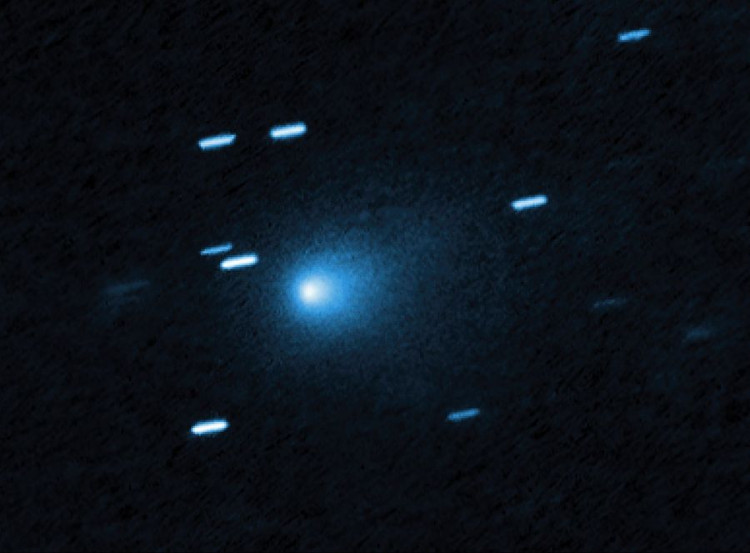
(Photo: NASA, ESA, David Jewitt (UCLA); Image Processing: Joseph DePasquale (STScI))
NASA's newest Hubble Space Telescope image of interstellar object 3I/ATLAS has intensified scientific scrutiny after confirming a sharply defined, sunward-pointing anti-tail-an alignment that astrophysicists say should not exist under standard comet physics. The November 30, 2025 image, captured with Hubble's Wide Field Camera 3 using the F350LP filter, shows a spherical glow extending 40,000 kilometres around the nucleus and a narrow, coherent sunward extension reaching approximately 60,000 kilometres.
The distinction matters because comets normally shed gas and dust that are forced away from the Sun by the solar wind. The result is a dust tail that curves outward and an ion tail pointed directly away from the Sun. The Hubble image shows the opposite: a stable, sunward-directed debris line. Scientists classify this as an anti-tail, but rarely is such a feature so sharply defined or so large. In this case, the structure aligns precisely with a prediction issued earlier by Harvard astrophysicist Avi Loeb.
Dr. Loeb has argued that 3I/ATLAS is shedding not volatile gas but "macroscopic non-volatile fragments," meaning solid objects far too large to be dispersed by the solar wind. He says these fragments separated during perihelion due to a measured non-gravitational acceleration that cannot be explained by thermal outgassing. His model predicted the fragments should appear about 60,000 kilometres sunward of the nucleus by November 30.
The newly released Hubble image shows the anti-tail emerging almost exactly where Dr. Loeb forecast, marking a rare alignment between real-time astrophysical prediction and observational confirmation. The spherical coma also remains unusually smooth and symmetric for an object that should be venting unevenly after its close solar passage, another indication-according to Loeb and others-that the debris field behaves differently from standard cometary physics.
Independent observations reinforce the anomaly. ESA's Juice spacecraft, Hubble's pre- and post-perihelion imaging sessions, and several ground-based amateur telescopes all show consistent structural features: a centered compact nucleus, a nearly perfect spherical halo, and a repeating sunward extension. That cross-platform consistency suggests the anti-tail is not an observational artifact but an intrinsic physical feature.
The confirmation arrives just weeks before a critical milestone. On December 19, 2025, 3I/ATLAS will make its closest approach to Earth, offering astronomers their final high-resolution window before the object recedes into the outer solar system. Researchers hope to examine whether the anti-tail remains coherent as the nucleus cools, whether the halo retains its symmetry, and whether the non-gravitational acceleration profile continues.
The answers matter because they challenge long-held assumptions about interstellar bodies. Unlike typical comets, 3I/ATLAS appears to eject large, solid fragments; maintain stable, symmetric structures; and generate debris patterns resistant to the solar wind. Each finding complicates established models of comet behaviour and suggests that interstellar objects may obey physical processes that differ from those governing native solar-system bodies.
Scientists are now preparing to test whether the anti-tail elongates, dissipates, or fractures as solar radiation weakens. The December 19 encounter will also help determine whether the nucleus brightens, dims, or maintains its unusual stability. The behaviour of 3I/ATLAS in the coming weeks will determine whether its anomalies represent an isolated curiosity or mark a broader class of interstellar visitors that behave in unfamiliar, non-volatile ways.