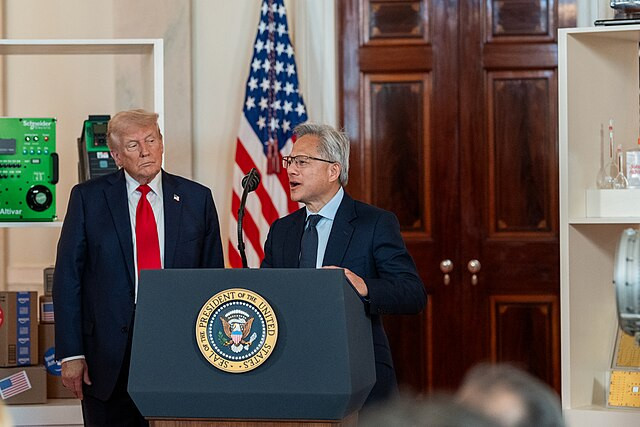
President Donald Trump moved to loosen export restrictions on artificial intelligence hardware, announcing that the United States will allow Nvidia's H200 chips-its second-most advanced AI semiconductors-to be shipped to China under a 25% fee structure. The move, disclosed in a Truth Social post and later clarified by White House officials, marks a significant reversal in Washington's effort to curtail Beijing's access to high-end computing power.
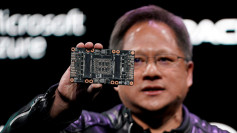
The decision follows Trump's meeting with Nvidia CEO Jensen Huang last week and opens a tightly controlled segment of the semiconductor market after months of internal debate. Nvidia's stock rose 2% in after-hours trading after the announcement, building on a 3% gain earlier in the day.
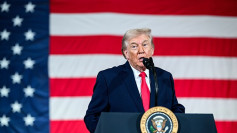
Trump said he informed Chinese President Xi Jinping of the policy shift, writing: "I have informed President Xi, of China, that the United States will allow NVIDIA to ship its H200 products to approved customers in China, and other Countries, under conditions that allow for continued strong National Security. President Xi responded positively!" Trump added that "25% will be paid to the United States of America," and a White House official confirmed the administration intends to collect a 25% import tax from Taiwan, where the chips are manufactured, before they undergo U.S. security review and are shipped to China.
Nvidia welcomed the move. "Offering H200 to approved commercial customers, vetted by the Department of Commerce, strikes a thoughtful balance that is great for America," the company said in a statement. Trump also said the Commerce Department is preparing a similar approach for AMD, Intel and other U.S. chipmakers, though Intel and AMD did not respond to inquiries.
The carve-out applies only to the H200 line and excludes Nvidia's more advanced Blackwell and Rubin systems, which are used by leading U.S. AI companies. "NVIDIA's U.S. Customers are already moving forward with their incredible, highly advanced Blackwell chips, and soon, Rubin, neither of which are part of this deal," Trump wrote.
The policy immediately drew bipartisan criticism from lawmakers and security analysts who warn that AI hardware exported to China could accelerate Beijing's military advances. Eric Hirschhorn, a former senior Commerce Department official, called the decision "a terrible mistake to trade off national security for advantages in trade," arguing it "cuts against the consistent policies of Democratic and Republican administrations alike not to assist China's military modernization."
The concerns reflect the performance gap between legally exportable chips and the incoming H200 approvals. A report from the Institute for Progress said the H200 is nearly six times more powerful than the H20, the most advanced chip currently allowed in China after the Trump administration reversed a brief export ban earlier this year. Nvidia's Blackwell chips-still blocked from the Chinese market-are roughly 1.5 times faster than the H200 for AI training tasks and five times faster for inference, with Nvidia research showing a tenfold acceleration in specific workloads.
China's own response remains uncertain. While its cybersecurity regulator recently summoned Nvidia to question whether the older H20 chip had "backdoor security risks"-an allegation Nvidia denied-experts expect Chinese firms to purchase H200 units if allowed. "China would almost certainly accept it," said Chris McGuire, a former State Department national security official. "It would be self-defeating not to, given the H200 is better than every chip the Chinese can make."
The announcement arrived the same day the Justice Department revealed it had disrupted a China-linked smuggling ring that attempted to funnel at least $160 million in Nvidia H100 and H200 chips overseas. Analysts say Trump's new framework is intended as a compromise-controlling the most advanced American hardware while avoiding a total embargo that could strengthen Chinese alternatives such as Huawei.
Still, skepticism persists in Washington. Several Democratic senators called the move a "colossal economic and national security failure," warning it would help China's industrial and military capacity. Others argue the policy risks undercutting the export-control regime that both the Trump and Biden administrations relied on to slow Beijing's progress in high-performance computing.