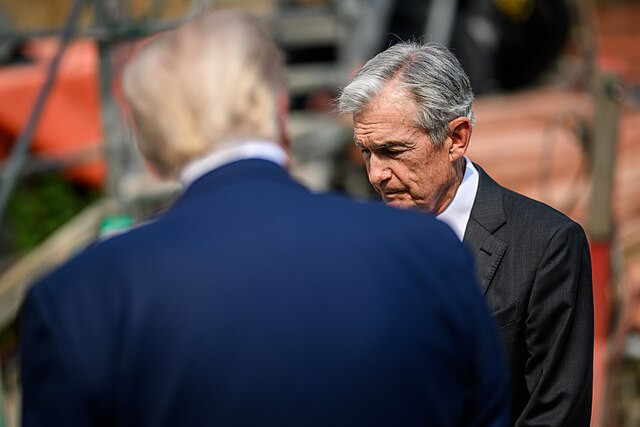
The Federal Reserve delivered its third interest-rate cut in four months and its lowest policy setting since 2022, but deep internal divisions and cautious guidance signaled that further easing will be harder to achieve and likely slower. The Federal Open Market Committee on Wednesday lowered the federal funds rate by 25 basis points to a range of 3.50% to 3.75%, even as a split vote and fresh forecasts underscored a central bank wrestling with inflation that remains above target, a fragile labor market and mounting political pressure from President Donald Trump as he prepares to name Chair Jerome Powell's successor.
The decision, widely described on Wall Street as a "hawkish cut," passed on a 9-3 vote and exposed a rare three-way split inside the Fed. Governor Stephen Miran dissented in favor of a larger half-point reduction, while Kansas City Fed President Jeffrey Schmid and Chicago Fed President Austan Goolsbee opposed any cut at all and backed holding rates steady. It was the first time since September 2019 that three FOMC members have broken with the majority, and it marked Miran's third consecutive "no" vote before his scheduled departure in January.
In its statement, the FOMC revived language last used a year ago, signaling a pivot from an active cutting cycle to a more data-dependent posture. "In considering the extent and timing of additional adjustments to the target range for the federal funds rate, the Committee will carefully assess incoming data, the evolving outlook, and the balance of risks," the statement said. When the same language appeared in December 2024, no further reductions followed until the Fed resumed easing in September.
Fresh projections released alongside the decision-the so-called dot plot-showed officials still expect only one additional cut in 2026 and another in 2027, after which the policy rate settles near a longer-run level of about 3%. Those dots were unchanged from September but masked substantial disagreement: seven officials indicated they want no cuts at all next year, and four nonvoting participants lodged "soft dissents," signaling they would have preferred a different decision. With 19 participants at each meeting and only 12 voting, Powell must manage a widening gap between hawks worried about persistent inflation and doves focused on labor-market risks.
The committee upgraded its outlook for growth, lifting its 2026 gross domestic product forecast by half a percentage point to 2.3%. At the same time, it projected that inflation will remain above the 2% target until 2028. The Fed's preferred inflation gauge most recently showed prices up 2.8% over the prior year in September-well below the peaks of the last tightening cycle but still noticeably above the central bank's goal.
Beyond interest rates, the Fed also adjusted its balance sheet strategy, responding to strains in short-term funding markets. After signaling in October that it would halt the runoff of its securities portfolio, the central bank said it will resume buying Treasurys, starting with $40 billion in Treasury bills on Friday. Purchases are expected to "remain elevated for a few months" before being "significantly reduced," a shift designed to stabilize overnight money markets without reversing the broader normalization of the balance sheet.
The meeting unfolded against a tense political backdrop as Powell approaches the end of his second term. He has just three meetings left before yielding the chair to Trump's nominee, who the president has openly suggested will be chosen for a bias toward easier money. Trump has signaled he will litmus test his choice for being in favor of lower rates rather than someone committed to the Fed's dual mandate of stable prices and full employment, and told reporters he expects to make a choice soon. Prediction markets have assigned high odds to National Economic Council Chair Kevin Hassett, with former Governor Kevin Warsh and current Governor Christopher Waller seen as trailing contenders.
Fed officials have also been operating with impaired visibility. A government shutdown that lasted until Nov. 12 delayed or disrupted key economic reports, leaving the committee to rely more than usual on partial and private-sector indicators. The data they do have point to what officials describe as a low-hire, low-fire labor market, with employers reluctant to either add or shed workers aggressively. But Challenger, Gray & Christmas reported that announced layoffs through November have topped 1.1 million, hinting at heavier payroll reductions ahead.
For households and markets, the cut brings the federal funds rate back to levels not seen since November 2022 and raises fresh questions about borrowing costs, especially for mortgages. Long-term home-loan rates don't move in lockstep with the Fed's benchmark, since they are driven more by inflation expectations and the 10-year Treasury yield than by the overnight rate. Because markets had been anticipating a 25-basis-point move for weeks, much of the effect was likely priced into mortgage rate sheets before the announcement.