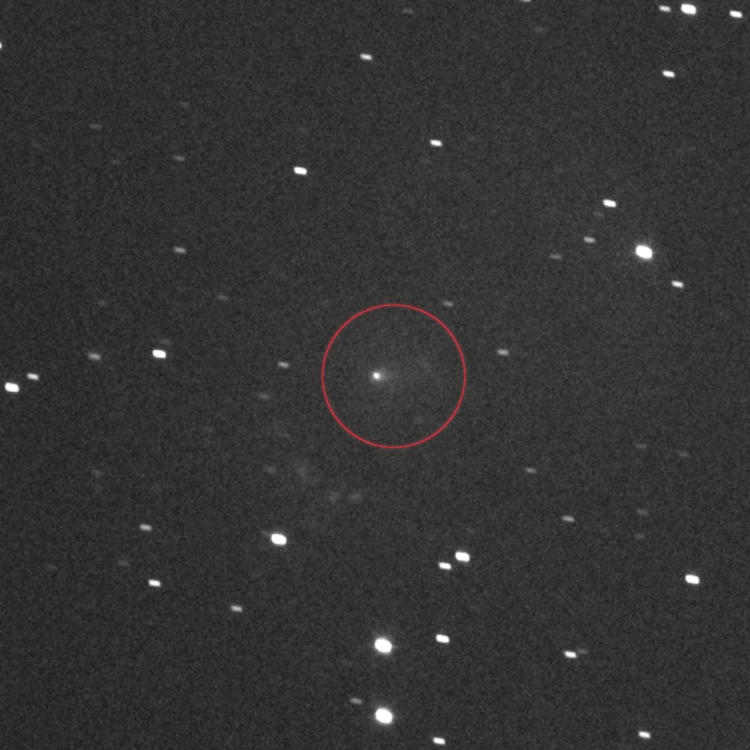
(Photo: NASA/Goddard/SwRI/JHU-APL)
Astronomers tracking the interstellar comet known as 3I/ATLAS report that the object has brightened markedly and developed a faint green glow as it approaches its closest pass by Earth, sharpening scientific interest in only the third confirmed visitor from beyond the solar system. The color shift, documented in late November observations, is being closely analyzed as a potential indicator of the comet's chemical makeup and thermal evolution as it responds to increasing solar heat.
Discovered in late June, 3I/ATLAS is traveling on a hyperbolic trajectory that confirms it is not gravitationally bound to the Sun. The object is moving at roughly 210,000 kilometers per hour, fast enough to traverse the inner solar system only once before exiting back into interstellar space. Its path and velocity place it alongside 1I/'Oumuamua and 2I/Borisov as the only known interstellar objects detected to date.
New imagery captured on Nov. 26 by the Gemini North telescope in Hawaii shows the comet surrounded by a diffuse coma emitting a greenish hue. Earlier observations from Gemini South in August had shown the object appearing redder, indicating a significant change as the comet moved closer to the Sun. Researchers say the shift reflects the onset of new outgassing processes rather than any structural transformation.
The green coloration is attributed to diatomic carbon, or C₂, a molecule commonly observed in comets as volatile ices sublimate under solar heating. As the gas is released and energized by sunlight, it emits light in the green portion of the spectrum. While such emissions are well documented among native solar-system comets, their detection in an interstellar object is considered especially valuable.
Scientists note that the green glow is confined to the comet's coma rather than its tail. That pattern aligns with established models showing that C₂ molecules are quickly broken apart by solar radiation, preventing them from surviving long enough to be carried into extended tails. The appearance of C₂ suggests that 3I/ATLAS has reached a thermal threshold where more complex carbon-bearing ices are beginning to sublimate.
Researchers believe 3I/ATLAS may be the largest and possibly the oldest interstellar object yet observed. Some estimates place its origin in the Milky Way's thick disk, which would imply an age of up to seven billion years-older than the solar system itself. If confirmed, that would make the comet a rare physical sample of material formed around another star long before the Sun existed.
The comet is scheduled to reach its closest approach to Earth on Dec. 19, passing at a distance of about 270 million kilometers. While there is no threat to the planet, astronomers are watching closely for potential late-stage activity. Because heat can take time to penetrate deep into a comet's interior, some researchers suggest additional outbursts could occur as new layers of ice begin to vaporize.
Such a delayed reaction could briefly increase the comet's brightness, offering ground-based and space-based telescopes a final opportunity to study its composition in detail. Instruments across multiple observatories are already coordinating observations to capture spectral data during this narrow window.