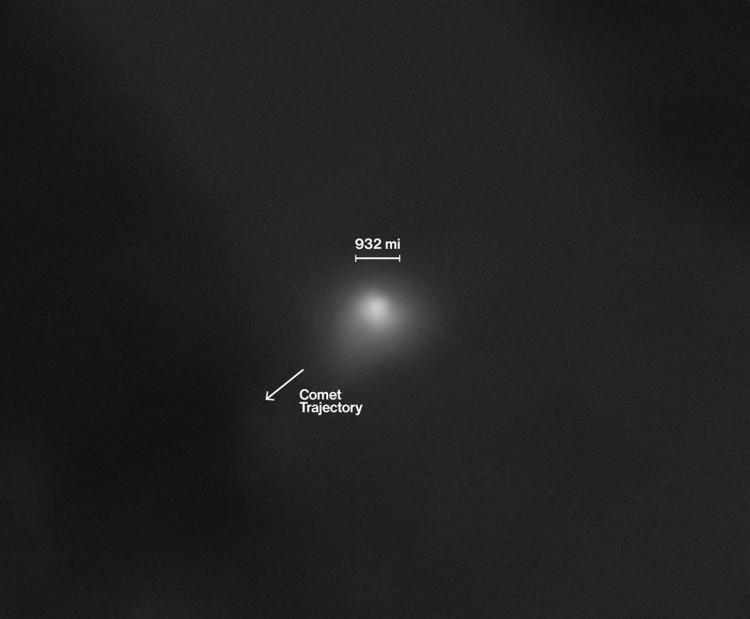
(Photo: NASA/JPL-Caltech/University of Arizona)
Astronomers monitoring the interstellar object known as 3I/ATLAS say new observations show an unexpected shift in the orientation of its rare "anti-tail" as the object approaches its closest point to Earth, adding fresh complexity to the scientific effort to understand material formed beyond the solar system. The change has been confirmed by multiple observatories and has become a focal point for debate over how dust and radiation interact in interstellar comets.
The object, only the third confirmed interstellar visitor detected passing through the solar system, has been under near-continuous observation as it nears perigee. Data from both professional and advanced amateur astronomers indicate that the dust structure pointing roughly toward the Sun has altered its apparent direction over time, a development that does not neatly align with conventional expectations of comet behavior.
An "anti-tail," though rare, is not unknown in cometary science. Such features typically arise from viewing geometry, when Earth passes through the plane of a comet's dust trail, producing the illusion that material is extending sunward rather than away from the Sun. In most cases, the apparent orientation remains consistent with orbital geometry.
What distinguishes 3I/ATLAS, researchers say, is that the anti-tail appears to have changed orientation as the object moves along its trajectory. The Nordic Optical Telescope reported that a dust trail once observed facing the Sun has since shifted direction as the comet approached perigee. Independent confirmation has come from observations involving the Hubble Space Telescope and the Gemini Observatory.
That apparent motion has prompted closer scrutiny of whether geometry alone can account for the behavior. Some researchers note that perspective effects can evolve as viewing angles change rapidly near perihelion or perigee, particularly for fast-moving interstellar objects on hyperbolic trajectories.
Harvard astrophysicist Avi Loeb has drawn attention to the apparent reversal of the anti-tail's orientation in images taken before and after perihelion relative to the comet's direction of motion at perihelion. He has argued that such behavior does not correspond cleanly with standard models describing how dust or gas responds to solar radiation pressure, a claim that has intensified discussion within the astronomical community.
Most comet specialists caution that extraordinary interpretations are unnecessary. They emphasize that interstellar comets may carry dust grain distributions and volatile compositions unlike those seen in native solar system objects, complicating interpretation of tail morphology. Rapid changes in illumination, particle size sorting, and projection effects can all contribute to apparent shifts in structure.
Key factors under examination include:
- The orientation of 3I/ATLAS's dust plane relative to Earth's line of sight
- The influence of solar radiation pressure on non-spherical or unusually large dust grains
- The role of outgassing rates as the object warms during its inner solar system passage
Despite the unusual visuals, the prevailing scientific view remains that 3I/ATLAS is a natural interstellar comet. Researchers see its evolving anti-tail as an opportunity rather than an anomaly, offering a rare laboratory for testing comet physics under conditions shaped by a different stellar environment.