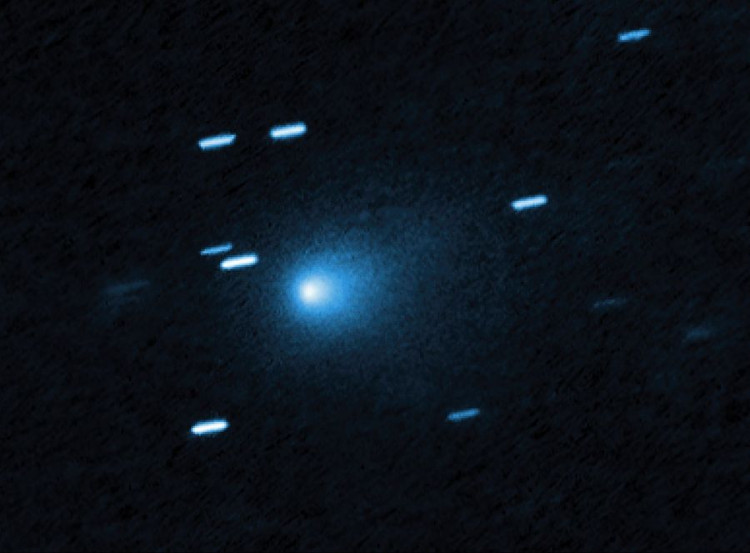
(Photo: NASA, ESA, David Jewitt (UCLA); Image Processing: Joseph DePasquale (STScI))
The passage of the interstellar object known as 3I/ATLAS through the inner solar system is prompting scientists and planetary-defense officials to reassess long-standing assumptions about how Earth identifies and prepares for potential cosmic threats. While the object itself poses no danger-its closest approach on Dec. 19 will occur at a distance of roughly 270 million kilometers-the circumstances of its arrival are underscoring vulnerabilities in existing detection and response frameworks.
For decades, planetary defense strategies have been built around asteroids and comets originating within the solar system. These objects typically follow stable, well-modeled orbits, allowing astronomers years or even decades to track them before any potential Earth encounter. Interstellar objects such as 3I/ATLAS operate outside that paradigm, entering the solar system at extreme speeds on hyperbolic trajectories that offer little advance warning.
The compressed timelines associated with these visitors challenge the foundational stages of planetary defense, which rely on early detection, detailed tracking and physical characterization before any mitigation options are considered. By the time an interstellar object is identified, it may already be deep inside the solar system, sharply limiting opportunities to study its structure, mass and composition.
That uncertainty is magnified by the unfamiliar physical behavior displayed by 3I/ATLAS. Observations suggest the object exhibits persistent sunward emissions and non-gravitational acceleration, meaning its motion cannot be explained by gravity alone. Such behavior complicates efforts to model how it responds to solar heating and radiation pressure-factors that are critical when assessing future hazards.
The issue is not the immediate safety of Earth but preparedness for a future scenario in which a similar object follows a more threatening trajectory. Planetary defense planning depends on predictability, and interstellar objects introduce variables that current models were not designed to handle.
Scientists expect discoveries like 3I/ATLAS to become increasingly common. The Vera C. Rubin Observatory in Chile, designed to scan the entire visible sky every few nights as part of its Legacy Survey of Space and Time, is expected to detect millions of solar-system bodies and a significant number of interstellar interlopers. Once fully operational, interstellar detections are likely to shift from rare events to routine observations.
That anticipated increase has implications well beyond astronomy. More frequent discoveries will force defense planners to confront scenarios in which rapid characterization is essential, yet observational data are sparse. Unlike familiar "rubble-pile" asteroids, interstellar objects may be structurally compact or chemically unusual, rendering standard deflection strategies uncertain.
Recent planetary defense successes demonstrate both progress and limitations. NASA's DART mission proved in 2022 that kinetic impact can alter an asteroid's orbit, and the European Space Agency's Hera mission will further study the effects of that test. However, those missions were designed around slow-moving, well-characterized targets-conditions that may not apply to a first-time visitor from another star system.