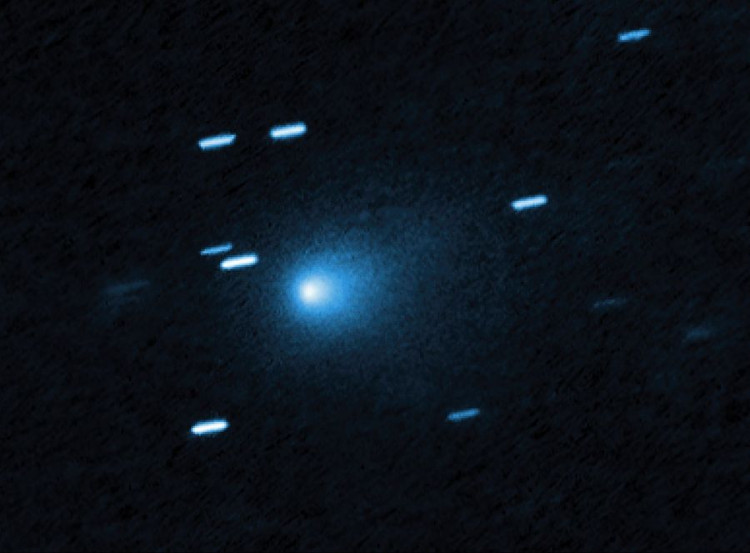
(Photo: NASA, ESA, David Jewitt (UCLA); Image Processing: Joseph DePasquale (STScI))
Astronomers are preparing for a rare observational opportunity as interstellar comet 3I/ATLAS approaches its closest point to Earth on Dec. 19, marking the nearest encounter humanity will ever have with the object. The visitor, which originated outside the solar system, is only the third confirmed interstellar body ever detected passing through Earth's neighborhood, offering scientists an unusually clear look at material formed around another star.
Discovered earlier this year by the ATLAS sky survey, 3I/ATLAS is traveling on a hyperbolic trajectory, meaning it is not gravitationally bound to the sun and will never return. Its path confirms that it was ejected from its original planetary system billions of years ago, likely after a close gravitational interaction with a massive exoplanet, before drifting through interstellar space until its brief passage through the inner solar system.
The comet's close approach significantly improves scientists' ability to analyze its composition. As it nears Earth, telescopes can more precisely measure the sunlight reflected and absorbed by its ices and dust, revealing chemical signatures that are otherwise difficult to detect at greater distances. These measurements are central to understanding how planetary systems form beyond the sun.
Interstellar objects are particularly valuable because they provide samples uncontaminated by the solar system's evolutionary history. Unlike native comets, which reflect conditions specific to the sun's protoplanetary disk, 3I/ATLAS preserves information about a different stellar environment. Its brief visit allows astronomers to compare the building blocks of planets across star systems.
Early observations suggest that 3I/ATLAS is rich in carbon dioxide, echoing findings from the second known interstellar comet, 2I/Borisov, discovered in 2019. That object displayed an unusually high abundance of carbon monoxide compared with water, a stark contrast to most solar system comets, which are dominated by water ice.
The chemistry of cometary ices provides clues about where they formed. Water ice condenses at relatively warmer temperatures, while carbon monoxide and carbon dioxide freeze only in much colder regions. The composition of 3I/ATLAS suggests it likely formed far from its parent star, at distances greater than where most solar system comets originated.
These findings are prompting scientists to reassess models of planet formation. One possibility is that many planetary systems produce comets at far greater distances than previously assumed. Another is that the solar system once formed similar distant objects, but gravitational upheaval during the migration of giant planets such as Jupiter and Saturn ejected them into interstellar space.
Researchers estimate that the solar system itself may have expelled tens of Earth masses' worth of comet-sized bodies during its early evolution. If that process is common, the Milky Way could be filled with similar interstellar debris, most of which passes unnoticed.