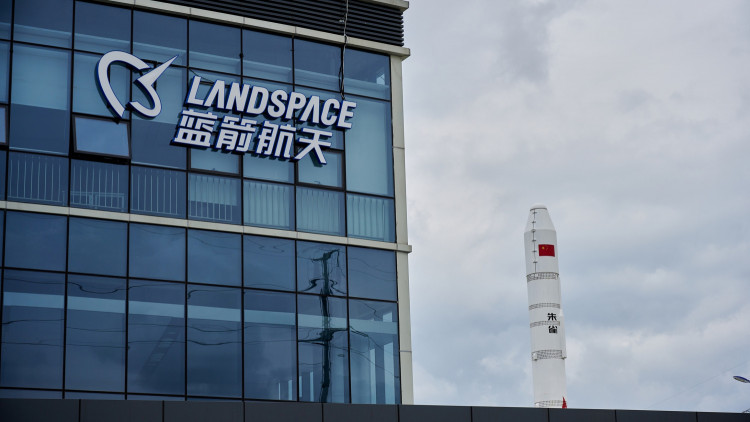
China's private space sector took another step toward commercial launch competition after Beijing-based startup LandSpace conducted the first test of its reusable Zhuque-3 rocket, a mission that ended in failure but underscored the country's accelerating push to challenge global launch providers such as SpaceX. The attempt, though unsuccessful, marked a milestone for China's fast-growing commercial aerospace industry and highlighted Beijing's willingness to tolerate early setbacks in pursuit of lower-cost orbital access.
The test, carried out earlier this month, ended when the Zhuque-3 booster failed to complete its landing sequence at an altitude of roughly three kilometers, preventing recovery of the vehicle. LandSpace confirmed the outcome while emphasizing that the flight produced valuable engineering data that will be applied to future attempts. The company has positioned the test as part of an iterative development process rather than a final demonstration.
LandSpace is seeking to build a reusable medium-lift rocket capable of supporting China's expanding satellite ambitions, including large constellations for communications and Earth observation. The company's strategy reflects a broader policy shift that began in 2014, when Beijing opened portions of its space sector to private investment after decades of state monopoly control.
Founded by engineers with backgrounds in state aerospace institutions, LandSpace has aimed to accelerate development cycles by borrowing ideas from commercial launch models pioneered in the United States. The Zhuque-3 rocket uses methane and liquid oxygen propellants and is designed with reusability in mind, a configuration now widely viewed as essential for reducing launch costs.
The company's chief designer, Dong Kai, previously worked at a state-owned rocket developer before joining the private sector. His move mirrored a wider migration of technical talent into startups seeking greater flexibility and faster iteration than traditional government programs allow.
The failed landing attempt echoed early efforts by SpaceX, whose Falcon 9 program experienced several unsuccessful recovery attempts before achieving consistent booster reuse in 2015. Analysts say such early failures are increasingly viewed inside China not as setbacks but as necessary data points in a competitive innovation cycle.
LandSpace has drawn attention not only for its technical ambitions but also for its unusual openness. The company has allowed international media access to its engine manufacturing facilities and has publicly discussed test outcomes, a marked departure from the traditionally opaque communication style of China's aerospace sector.
The emergence of firms like LandSpace coincides with Beijing's broader push to expand satellite infrastructure, reduce dependence on foreign launch providers, and support commercial players capable of serving both domestic and international customers. Regulators have also taken steps to streamline approvals and prepare certain private aerospace firms for eventual public listings.
The competitive environment now includes several Chinese startups racing to develop reusable launch vehicles, alongside state-backed programs pursuing parallel technologies. Together, these efforts aim to lower costs and increase launch frequency as demand rises for broadband constellations, Earth observation platforms, and national security payloads.
While Zhuque-3's first test did not achieve a recovery, industry analysts note that early-stage failures are typical in reusable launch development. The coming test cycles are expected to focus on refining landing systems, propulsion stability and guidance controls, areas that will determine whether LandSpace can move from experimental flights to operational launches.