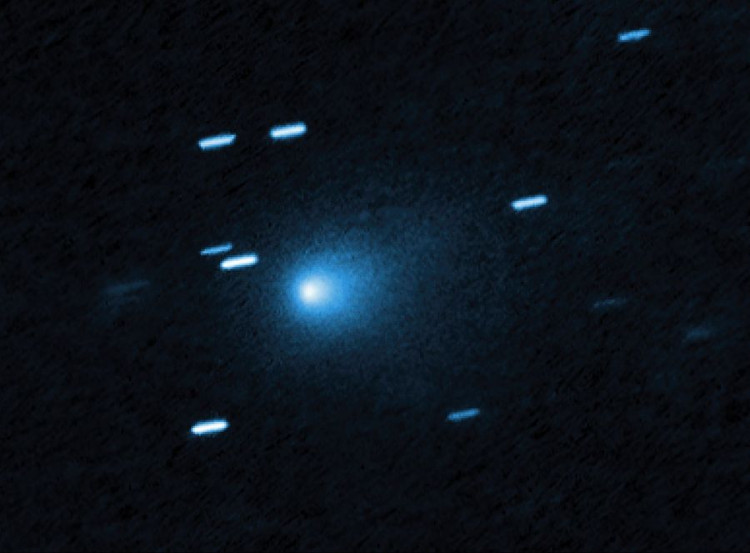
(Photo: NASA, ESA, David Jewitt (UCLA); Image Processing: Joseph DePasquale (STScI))
A newly analyzed set of images from the Hubble Space Telescope has intensified scientific debate over 3I/ATLAS, a rare interstellar object that passed through the solar system late last year, with Harvard astrophysicist Avi Loeb arguing that its unusual behavior could be consistent with artificial design rather than a conventional comet.
Discovered on July 1, 2025, by the ATLAS survey in Chile, 3I/ATLAS is only the third known interstellar object detected entering the solar system. Traveling on a hyperbolic trajectory at more than 50 kilometers per second, the object passed Earth on Dec. 19 at a distance of roughly 1.35 astronomical units, or about 200 million kilometers, allowing extensive observation without posing a risk.
Newly processed Hubble observations from Dec. 12 and Dec. 27 show what researchers describe as a persistent "double jet" structure extending up to 100,000 kilometers from the object's nucleus. One jet points roughly toward the Sun, while a second appears offset, a configuration that Loeb says is difficult to explain using standard comet physics.
In a recent analysis, Loeb wrote that "one possibility is that the two jets are launched from opposite sides of the nucleus." He added that under this interpretation, "the post-perihelion activity of 3I/ATLAS" differs from what was observed before its closest solar approach, suggesting heat transfer effects or asymmetric outgassing.
Loeb also outlined a second scenario that departs from conventional astrophysics. "For a technological object, the sunward jet might be utilized for protection against the solar wind, coronal mass ejections or sunlight - given that the anti-tail is marginally opaque," he wrote. In that case, he added, a second jet could function as a shield against interstellar debris encountered during high-speed travel.
The Harvard scientist further noted that "both jets are expected to show a high-speed exceeding 1 kilometer per second at their launch points near the nucleus" if they are actively controlled. He argued that measuring these velocities could help distinguish between natural and engineered explanations.
The object's behavior has stood out even among rare interstellar visitors. Unlike 1I/ʻOumuamua, which showed no clear coma, or 2I/Borisov, which behaved like a conventional comet, 3I/ATLAS developed activity only after passing perihelion on Nov. 30 at about 1.4 astronomical units from the Sun. Its delayed activation and sun-facing "anti-tail" have become central to the debate.
Loeb previously wrote that the object's brightness variations, non-gravitational acceleration and jet orientation form a pattern that merits scrutiny. He has described the possibility that it could be a technological artifact as one of several hypotheses rather than a definitive conclusion.
In a blog post, he wrote that a more speculative interpretation would treat the structure as part of a "protection" mechanism, adding that such a configuration could shield a craft from "solar wind, coronal mass ejections or sunlight." He emphasized that further data are required before drawing conclusions.
Astronomers outside Loeb's camp remain cautious. Most researchers interpret the observations as consistent with an unusually active comet composed of volatile ices such as carbon monoxide or metal-rich compounds. NASA has said the observed non-gravitational forces can be explained by asymmetric outgassing rather than propulsion.
Still, Loeb has argued that the object's behavior warrants deeper investigation. He has called for spectroscopic follow-up using facilities such as the Keck Observatory in Hawaii and the Very Large Telescope in Chile to determine whether jet velocities and compositions align with natural expectations.
Preliminary spectra suggest exotic ices, but higher-resolution data are needed to test whether the jets accelerate in ways consistent with engineered systems. Loeb wrote that if both jets originate from the sun-facing side and accelerate outward, it could challenge standard comet models.