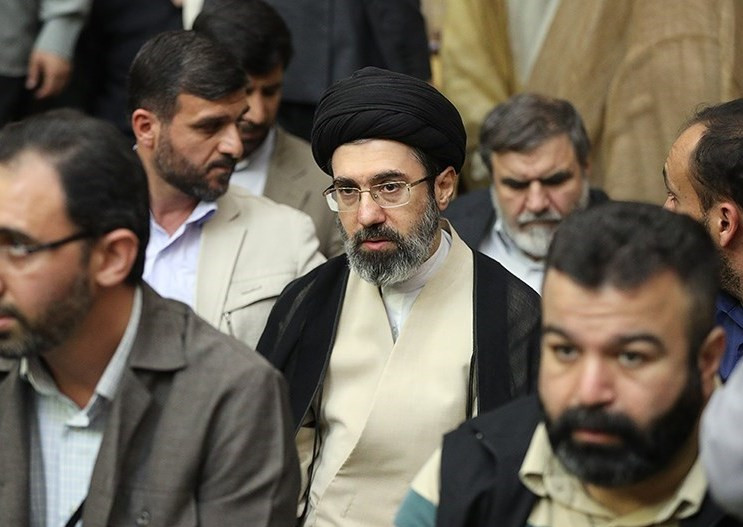
Reports circulating in Iranian and regional media have thrust Mojtaba Khamenei, the son of Iran's Supreme Leader Ayatollah Ali Khamenei, into the spotlight after claims that the elder Khamenei was killed during U.S. and Israeli strikes on Feb. 28. The reports, which remain unconfirmed, suggest Mojtaba could be positioned as the next leader of the Islamic Republic, though the country's constitutional process for selecting a supreme leader has not been formally documented in connection with the claims.
The speculation comes amid intense geopolitical tension following the reported strikes. While Iranian authorities have not verified the death of the supreme leader, discussions about possible succession have intensified among analysts and regional observers, with Mojtaba Khamenei frequently cited as a potential candidate within Iran's opaque power structure.
Mojtaba Khamenei, a cleric and the second-eldest son of Ali Khamenei, has long been viewed by some insiders as one of the most influential members of the ruling family despite holding no major elected office. Born in Mashhad on Sept. 8, 1969, he spent portions of his early life in Sardasht and Mahabad before pursuing religious education in the clerical center of Qom beginning in 1999.
His biography also includes service during the Iran-Iraq War, where he reportedly fought between 1987 and 1988, a credential that continues to carry symbolic importance within the Islamic Republic's political narrative.
If the reports about succession prove accurate, the transition would mark one of the most consequential leadership changes in Iran since Ali Khamenei assumed the role of supreme leader in 1989. Under Iran's constitution, the Assembly of Experts is responsible for appointing a new supreme leader, though temporary arrangements may be put in place if the position becomes vacant.
Media reports have suggested the possible formation of an interim leadership council to manage the office during the transition. Accounts differ about the structure of that body, with Al Jazeera describing a three-member interim council, while other sources have referenced a group of four officials assuming temporary authority.
The uncertainty underscores the difficulty of interpreting internal political dynamics in Tehran from outside the country.
Mojtaba Khamenei's influence has been widely debated inside and outside Iran for years. Critics and reformist figures have alleged he exercised behind-the-scenes power in key institutions, including the Basij militia, a paramilitary force linked to Iran's Islamic Revolutionary Guard Corps.
The controversy surrounding his role intensified following the disputed 2009 Iranian presidential election. Reformist candidate Mehdi Karroubi accused Mojtaba in an open letter of involvement in a conspiracy to manipulate the vote in favor of then-President Mahmoud Ahmadinejad.
Ahmadinejad himself later accused Mojtaba Khamenei of financial misconduct, alleging that he had embezzled funds from the state treasury. Those allegations have remained contested and unresolved.
Questions about Mojtaba's financial influence have also surfaced in international reporting. While no verified public figure exists for his wealth, several investigations have described allegations of significant assets tied to networks of companies and intermediaries.
According to reporting cited in public profiles, The Guardian and Libération have referenced claims that Mojtaba controls substantial financial resources, though those claims have been disputed by political figures associated with his extended family.
A Bloomberg investigation published in January 2026 reported that Mojtaba Khamenei had been linked to an offshore network holding assets abroad. The investigation said those holdings allegedly included high-value real estate in London and Dubai, as well as interests connected to shipping, banking relationships and hospitality properties in Europe.
Bloomberg reported that many of the assets were structured through intermediaries and layered corporate entities rather than being held directly in Mojtaba's name.
One figure mentioned in connection with those allegations is Ali Ansari, an Iranian businessman sanctioned by the United Kingdom. Ansari has denied any wrongdoing and said he would challenge the sanctions.
The United States has also taken action against Mojtaba Khamenei. In 2019, the U.S. government imposed sanctions on him, alleging he had acted on behalf of the supreme leader without holding an official position and maintained ties with senior figures in the Quds Force, an elite unit of Iran's Revolutionary Guard.