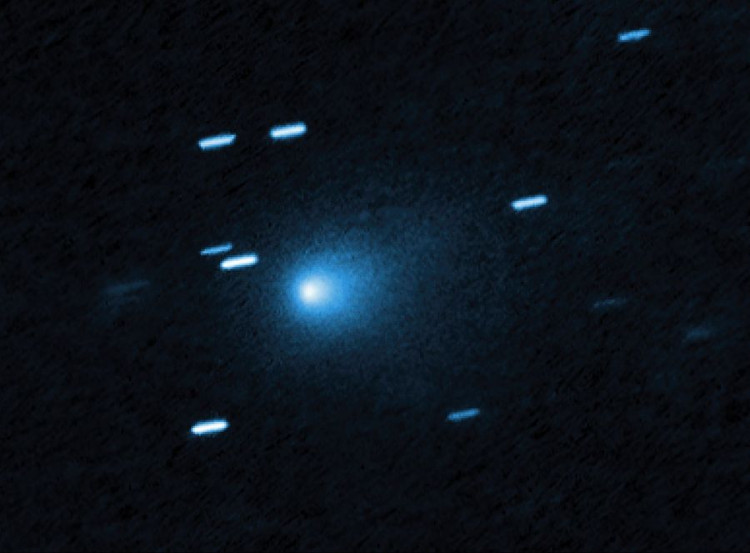
(Photo: NASA, ESA, David Jewitt (UCLA); Image Processing: Joseph DePasquale (STScI))
Fresh observations from the Hubble Space Telescope have intensified debate over the nature of 3I/ATLAS, a fast-moving interstellar object whose unusual jet behavior has drawn scrutiny from astronomers including Harvard astrophysicist Avi Loeb. Images captured in mid- and late December show a stable, dual-jet structure that appears to operate in a coordinated, rhythmic pattern, raising questions about whether the object behaves like a conventional comet or something more complex.
The data, collected on Dec. 12 and Dec. 27 using Hubble's Wide Field Camera 3 (WFC3) in ultraviolet and visible wavelengths, reveal two distinct jets extending from the object's nucleus. Processed with a Larson-Sekanina rotation gradient filter, the images show that as one jet brightens, the other fades, a pattern that repeats with notable regularity.
Researchers tracking 3I/ATLAS say the behavior stands out because it persists well after the object's closest approach to the Sun. Most cometary bodies show declining or chaotic outgassing at that stage, yet this object maintains structured activity. The jets appear geometrically stable, implying fixed source regions on or near the nucleus.
Professor Avi Loeb, who has closely followed the object's evolution, has emphasized that the observed pattern aligns with a previously reported brightness modulation cycle of roughly 16 hours. He has described this as a form of rotational "heartbeat," noting that the alternating intensity suggests a wobble rather than random venting. "You can't just say, 'I know the answer' and ignore the anomalies. That's not viable," Loeb said.
One natural explanation outlined by Loeb proposes that the jets originate on opposite sides of the nucleus, switching dominance as solar heating rotates into and out of view. This scenario would require highly efficient internal heat transport, a property that remains uncertain for an object believed to have formed outside the solar system.
A second hypothesis keeps both jets on the sun-facing side but attributes their differing behavior to particle composition. In this model, larger dust grains form a persistent "anti-tail," while smaller particles are pushed back by solar radiation pressure, producing a shorter, dimmer jet whose brightness varies with orientation.
Even this explanation, however, leaves unresolved geometric inconsistencies. Earlier observations suggested the sun-facing pole identified in July should now lie on the night side, yet the same directional jet activity persists. That persistence has become one of the central puzzles surrounding 3I/ATLAS.
The object's speed adds to the intrigue. Traveling at roughly 130,000 miles per hour, it is the fastest interstellar visitor yet recorded, implying a long acceleration history through interstellar space. Its velocity and stability have made it a prime target for further scrutiny.