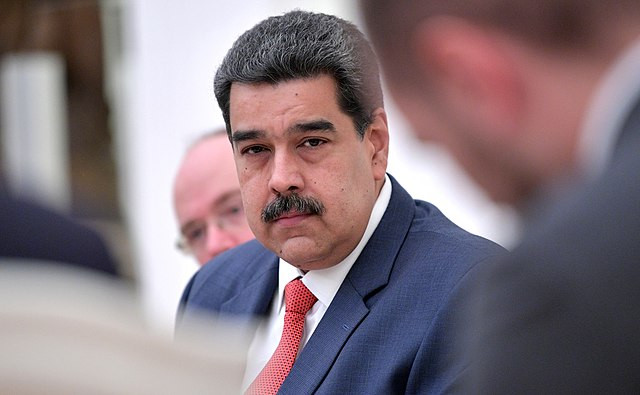
The United States launched overnight military strikes on Venezuela early Saturday, after which President Donald Trump announced on social media that Venezuelan leader Nicolás Maduro and his wife, Cilia Flores, had been captured and removed from the country, a claim that immediately sent shockwaves through Latin America and raised fears of a broader regional confrontation.
Trump posted that "the United States of America has successfully carried out a large-scale strike against Venezuela and its leader, President Nicolas Maduro, who has been, along with his wife, captured and flown out of the Country," adding that the operation had been conducted "in conjunction with US Law Enforcement" and that "details [were] to follow." No independent confirmation of the alleged capture was immediately available.
The announcement followed hours of explosions reported across Caracas and surrounding states beginning around 2 a.m. local time. Residents described low-flying aircraft and repeated blasts striking areas in Miranda state, which includes the capital, as well as Aragua and La Guaira. Images circulating online showed smoke and flames rising from multiple sites, including a fire at Fuerte Tiuna, the country's largest military complex.
"The whole ground shook. This is horrible. We heard explosions and planes in the distance," Caracas resident Carmen Hidalgo told the Associated Press. "We felt like the air was hitting us." Power outages were reported in several neighborhoods as civilians fled streets amid the strikes.
U.S. authorities moved quickly to restrict air traffic. The Federal Aviation Administration barred U.S. commercial flights from Venezuelan airspace, citing "ongoing military activity," while the U.S. Embassy in Caracas urged Americans not to travel to the country and advised those already there to depart as soon as possible.
Venezuela's government denounced the attacks as an act of "aggression" and a violation of international law, rejecting Trump's claims and accusing Washington of seeking control over the country's resources. In a statement, officials said the true objective was "none other than to seize Venezuela's strategic resources, particularly its oil and minerals, attempting to forcibly break the nation's political independence." The statement added: "They will not succeed."
Maduro responded by declaring a state of emergency and ordering the implementation of national defense plans, expanding military authority and allowing the suspension of certain civil rights. In a message broadcast by state media, the government urged citizens to mobilize, saying: "Today, with the spirit of Bolivar, Miranda, and our liberators, the Venezuelan people rise up once again to defend their independence against imperial aggression. People, take to the streets!"
The strikes came days after Maduro told Spanish journalist Ignacio Ramonet that his government was "ready" for "serious" discussions with the United States on combating drug trafficking, remarks that now appear overtaken by events. Tensions had already escalated following reports of earlier U.S. drone activity targeting alleged smuggling infrastructure.
Regional leaders reacted sharply. Colombian President Gustavo Petro warned that a neighboring nation had been attacked and called for emergency meetings of the Organization of American States and the United Nations, writing that "right now they are bombing Caracas." Cuban President Miguel Díaz-Canel described the operation as "criminal activity" and accused Washington of "state terrorism."