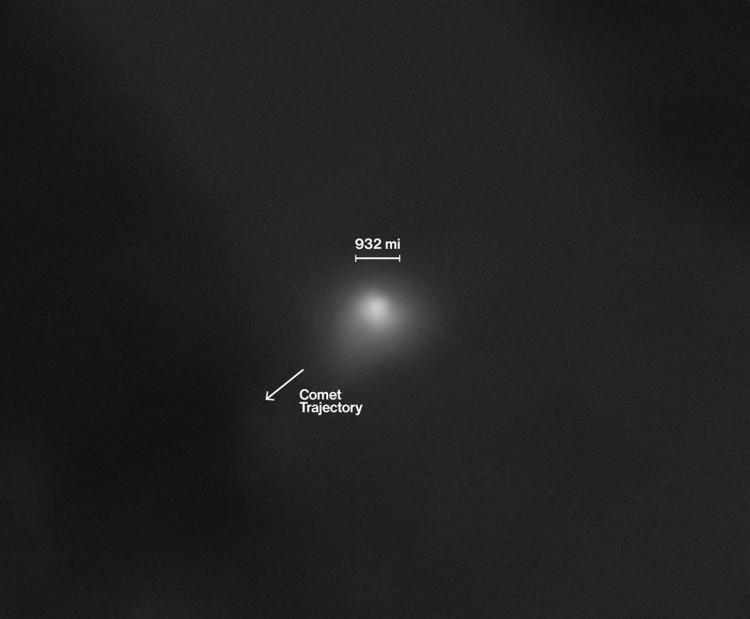
(Photo: NASA/JPL-Caltech/University of Arizona)
A faint interstellar object detected in July 2025 has quietly reshaped how scientists and security planners view threats from deep space, after analysts concluded it passed hundreds of millions of miles from Earth before being identified. Known as 3I/ATLAS, the object is only the third confirmed visitor from outside the solar system and is now being examined not only as a scientific anomaly but as a test of planetary defense readiness.
The object was first recorded at 05:15:11 UT on July 1 by the NASA-funded Asteroid Terrestrial-impact Last Alert System, or ATLAS, operating from Rio Hurtado, Chile. Initial images showed little more than a faint moving point, but follow-up orbital calculations quickly revealed a hyperbolic trajectory, confirming the object was not gravitationally bound to the Sun.
Within hours, astronomers determined that 3I/ATLAS was traveling too fast and at too steep an angle to have originated from within the solar system. Subsequent reconstruction of its path using archival observations from multiple survey facilities traced its arrival to the direction of the Sagittarius constellation, a dense region associated with star formation and stellar disruption.
At the time of discovery, the object was approximately 420 million miles from Earth, a distance that scientists described as close in astronomical terms. What unsettled researchers was not proximity alone, but the realization that an interstellar body could traverse that distance before being flagged by automated detection systems designed primarily for near-Earth objects.
Early observations showed none of the dramatic brightening or tail formation typical of icy comets approaching the Sun. Its subdued brightness profile suggested an object that was either compositionally unusual or behaving in ways not captured by existing models. Later data complicated the picture further, revealing non-gravitational acceleration and unexpected jet activity.
Analysis from the James Webb Space Telescope indicated a carbon-dioxide-to-water ratio of roughly 8:1, a chemical signature unlike that of known solar-system comets. Scientists said the finding confirmed the object formed under conditions far different from those around the Sun.
Despite being distant from peak solar heating, 3I/ATLAS was observed releasing water vapor at an estimated rate of about 40 kilograms per second. Researchers noted that if a similarly fast-moving object had been on a collision course, warning times could have been measured in weeks rather than months.
The detection has renewed debate about how many interstellar objects may have passed unnoticed before modern sky surveys. ATLAS, originally designed for asteroid impact prevention, has effectively become the world's primary interstellar early-warning system by default rather than design.
Avi Loeb, a leading voice in the study of interstellar objects, said such visitors provide a rare scientific opportunity, describing them as samples of "material formed around other stars." He and other researchers have argued that understanding these objects carries implications beyond astronomy.