President Donald Trump said Russian naval forces withdrew rapidly from the North Atlantic as U.S. and allied forces seized a sanctions-evading oil tanker, publicly mocking Vladimir Putin and framing the episode as a blow to Moscow's claims of maritime dominance.
The incident centers on the tanker Marinera, formerly known as Bella 1, which U.S. officials say was transporting illicit Venezuelan oil as part of Russia's so-called shadow fleet. The seizure represents one of the most visible enforcement actions to date under Washington's expanded blockade targeting sanctioned energy flows tied to both Russia and Venezuela.
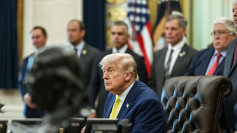
Speaking in an interview with Fox News, Trump described the moments before the boarding operation, asserting that Russian warships abandoned the area once U.S. forces arrived. "I don't want to say that, but the fact is that the Russian ships - it was a submarine and a destroyer - they both left very quickly when we arrived," Trump said. He added that U.S. forces "successfully took control of the ship" and that the oil cargo is now being unloaded.
The tanker had previously appeared on Russia's official ship registry after its crew painted a Russian flag on the hull during pursuit, a move Moscow argued placed the vessel under Russian protection. U.S. officials rejected that claim, treating the ship as stateless and subject to seizure under federal court warrants tied to sanctions violations.
The operation has heightened tensions between Washington and Moscow at a moment when maritime enforcement has become a central pressure point in U.S. foreign policy. Trump has described the seizures as part of a broader effort to choke off funding streams tied to sanctioned regimes and criminal networks.
Moscow's response was swift and caustic. Dmitry Medvedev, deputy head of Russia's Security Council, denounced the operation as a "criminal seizure of a civilian vessel" and labeled Trump a "madman." Medvedev said global politics had descended into "outright Bedlam," arguing that Western leaders needed "straitjackets" rather than diplomacy.
Investigative reporting by Radio Liberty and the System project has linked the Marinera to sanctions-evasion networks associated with Viktor Baransky and Ilan Shor, figures described by analysts as critical intermediaries in moving oil and capital through opaque maritime channels. The vessel, researchers said, functioned as more than a tanker, serving as a financial artery for Kremlin-aligned operations.
Shortly after the seizure, Russia launched a new wave of missile strikes across Ukraine, including a strike near Lviv involving the nuclear-capable Oreshnik system. Ukrainian commentators argued the timing was deliberate, portraying the attacks as symbolic retaliation rather than battlefield necessity.
Journalist Denis Kazansky said such actions are often used by the Kremlin to deflect from strategic setbacks, noting that civilian areas are frequently targeted to "ease the humiliation" following military or political reversals. Open-source intelligence group InformNapalm suggested the Oreshnik strike may have been conducted without an explosive payload, characterizing it as political signaling rather than escalation.
Ukrainian President Volodymyr Zelensky called for a stronger international response, urging the United States and its allies to accelerate air-defense deliveries and ensure Russia "feels the consequences" of continued aggression.