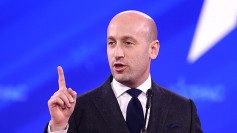
A newly released tranche of records tied to Jeffrey Epstein has ignited a political and legal backlash after a photograph of Donald Trump appeared with his face conspicuously blacked out, despite the image depicting a public event. The redaction emerged within materials published by the U.S. Department of Justice under federal court supervision, part of a continuing effort to unseal documents related to Epstein's communications and associations.
At the center of the dispute is a 2019 text-message exchange between Epstein and Steve Bannon, a former senior adviser to Trump. Embedded in the exchange is a photograph showing Trump at a podium addressing an audience, consistent with a campaign or public appearance. In the released version, Trump's face is covered by a solid black box while the rest of the image remains visible.
The Justice Department has said its redactions are narrowly applied to protect victims, minors and private individuals. Yet the decision to obscure the face of a sitting president in a publicly sourced photograph has prompted questions about consistency and judgment. No explanatory note accompanies the redaction, and the department has not publicly detailed why this image required alteration.
Legal analysts reviewing the release noted that standard redaction practice typically removes identifying details of victims or sensitive personal data, not the face of a well-known public figure in a public setting. Several former federal prosecutors described the move as unusual, arguing that it neither advances victim protection nor clarifies the evidentiary record.
The image itself does not allege criminal conduct. It confirms only that Epstein and Bannon exchanged an image of Trump during their communications in 2019, years after Epstein's 2008 conviction and shortly before his death in federal custody. Trump's social interactions with Epstein in the 1990s and early 2000s have long been documented, and no charges have ever been brought against Trump in connection with Epstein's trafficking operation.
The selective nature of the redaction has intensified criticism of the broader Epstein-files rollout, which has already faced scrutiny over inconsistent masking, missing attachments and delayed uploads. Open-records advocates argue that unexplained redactions create an interpretive vacuum, inviting speculation and undermining confidence in the release process.
Advocacy groups representing Epstein's victims have separately cautioned that a chaotic or opaque disclosure risks retraumatizing survivors while eroding trust in the justice system. The department has reiterated that its approach balances transparency with legal obligations, but has not addressed why Trump's face-rather than the entire image-was obscured.