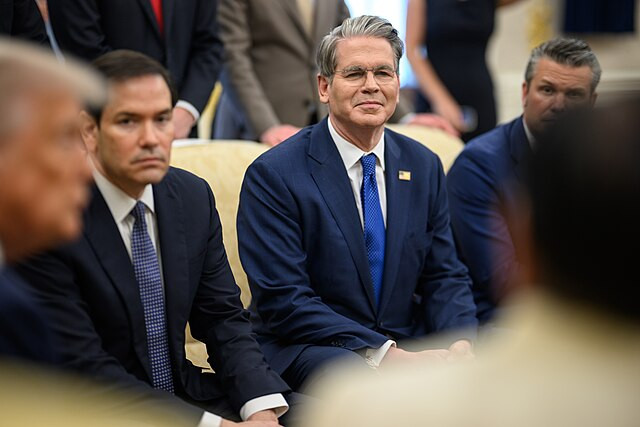
Gold prices retreated sharply over the past week, snapping a historic rally, as U.S. Treasury Secretary Scott Bessent attributed the sudden correction to speculative trading behavior in China and pointed to broader signs that the U.S. economy is entering an upward cycle.
The pullback in bullion coincided with a rebound in the U.S. dollar, a recovery in equities, and fresh optimism following President Donald Trump's nomination of Kevin Warsh as chairman of the Federal Reserve. The Dow Jones Industrial Average also crossed the 50,000 mark for the first time, reinforcing a shift in investor sentiment away from safe havens.
Bessent said the turbulence in gold was driven less by U.S. fundamentals than by overseas speculation. "The gold move thing - things have gotten a little unruly in China," Bessent said in a media interview. "They're having to tighten margin requirements. So gold looks to me kind of like a classical, speculative blowoff."
His remarks highlighted the role of leverage in recent price swings. Chinese authorities, he said, were forced to rein in margin trading, a step typically used to cool rapid gains fueled by borrowed money rather than underlying demand.
Despite the metal's reversal, Bessent framed the broader market backdrop as constructive for the U.S. economy, particularly ahead of midterm elections. "In my 35-40 years on Wall Street, that tells me Wall Street is telling you that Main Street is about to prosper," he said, pointing to record highs in the Dow and strength in small-cap stocks. "The stock market lives in the future."
On monetary policy, Bessent signaled patience from the Federal Reserve, especially regarding any reduction of its balance sheet. "I wouldn't expect them to do anything quickly. They've moved to the ample-regime policy, and that does require a larger balance sheet, so I would think that they'll probably sit back, take at least a year to decide what they want to do," he said.
He also addressed concerns about political influence over the central bank, saying Warsh is "going to be very independent, but mindful that the Fed is accountable to the American people."
The gold correction has drawn additional scrutiny from prominent investors. Michael Burry, known for predicting the 2008 financial crisis, recently warned that further declines in Bitcoin could accelerate stress across markets. He argued that falling crypto prices forced corporations to de-risk by selling profitable positions tied to tokenised gold and silver futures.
Burry cautioned that if Bitcoin dropped to $50,000, "tokenised metals futures would collapse into a black hole with no buyer," underscoring his view that synthetic exposure can overwhelm physical markets. Bessent echoed the need for clearer rules in the digital-asset space, urging swift passage of crypto market-structure legislation and arguing that regulatory clarity is essential if the U.S. aims to become the "crypto capital of the world."