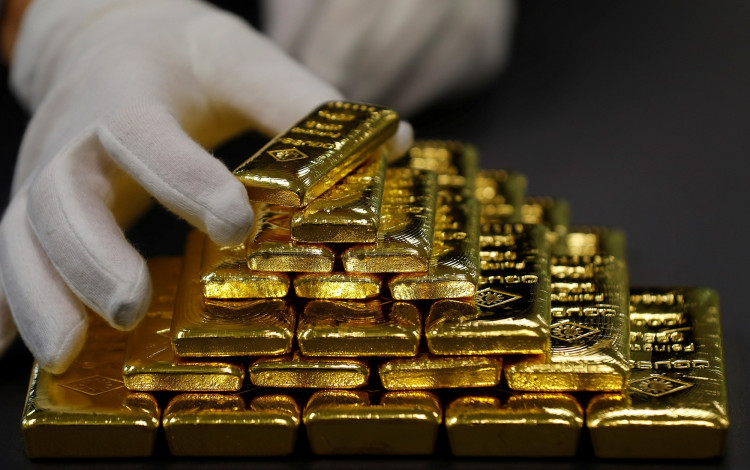
Gold and silver surged to fresh record highs while European equities fell sharply after Donald Trump threatened sweeping tariffs on eight European countries in an escalating campaign tied to his demand for U.S. control of Greenland. The move has intensified geopolitical anxiety, driving investors toward safe-haven assets and pressuring risk-sensitive stocks across Europe.
U.S. gold futures for February delivery rose 1.71% to $4,674.20 an ounce, while spot gold climbed 1.6% to $4,668.14. Silver outpaced gold, with U.S. futures touching a record $94.08 an ounce before easing slightly, underscoring the depth of investor demand for precious metals amid rising political and economic uncertainty.
Market participants pointed to Trump's weekend announcement that the U.S. would impose a 10% tariff from Feb. 1 on goods from Denmark, Norway, Sweden, France, Germany, the UK, the Netherlands and Finland, rising to 25% by June 1 if no agreement is reached on Greenland. In a post on Truth Social, Trump said the tariff would remain in place "until such time as a Deal is reached for the Complete and Total purchase of Greenland."
The reaction across European markets was swift. France's CAC 40 fell 1.6%, Germany's DAX declined 1.3%, and the FTSE 100 slipped 0.5%. Automakers were among the hardest hit, with Volkswagen, BMW and Mercedes-Benz falling between 2.5% and 4%, while Stellantis dropped roughly 2%.
"For businesses, the developments over the weekend mean another period of uncertainty around investments in and exports to the US," said Carsten Brzeski. He added that Europe's single-market structure could blunt the impact of tariffs, noting that "options for tariff evasion from the six countries mentioned by Trump are plentiful."
Precious-metal investors, by contrast, have leaned into the volatility. "Gold's rally has been powerful, but it has also been grounded in fundamentals that are still very much in place," said George Cheveley. He added: "With real rates likely to fall and central banks continuing to diversify their reserves, we see more reason for gold to consolidate or edge higher than to sell off sharply."
Silver's rise reflected both safe-haven demand and its industrial uses. Spot silver traded around $93.16 an ounce, up more than 3%, as investors balanced geopolitical risks against longer-term demand linked to electrification and data-center infrastructure.
Currency markets echoed the flight to safety. The dollar weakened against traditional havens, falling as much as 4% versus the Swiss franc and slipping against the Japanese yen, before paring losses later in the session.
Economists warned the trade threat could have measurable economic consequences if implemented. ING estimates additional tariffs could shave 0.2 percentage points off European GDP growth. Paul Dales said the UK could face a larger hit, adding: "The long-term political and geopolitical consequences would be much greater."
Analysts also linked the metals rally to a broader backdrop of global tension, including ongoing conflict in Ukraine, the slow path toward stability in Gaza, and uncertainty surrounding U.S. monetary policy amid Trump's public pressure on the Federal Reserve. "With Trump throwing tariffs into the mix, it is clear that his threat to Greenland is real," said Matt Simpson. "Geopolitical tensions have given the gold bulls yet another reason to push it to new highs."