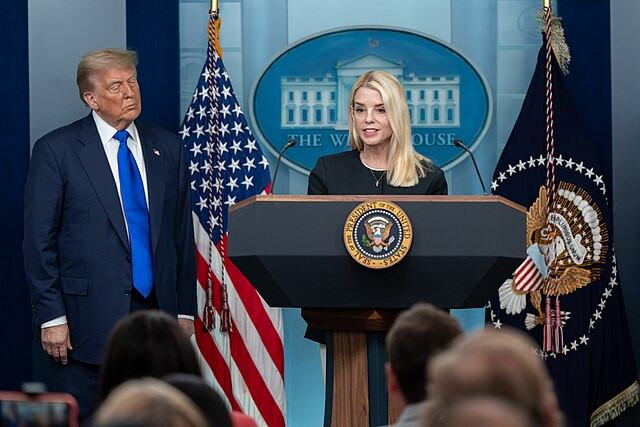
U.S. Attorney General Pam Bondi's long professional relationship with President Donald Trump is again under scrutiny, as critics point to a series of legal decisions dating back to 2013 that they argue demonstrate a pattern of alignment with the president's political and legal interests.
The relationship traces to Bondi's tenure as Florida attorney general, when her office was considering whether to join other states in investigating Trump University, an educational program promoted by Trump that faced allegations of fraud. At the time, Trump had marketed the program by stating, "At Trump University, we teach success. That's what it's all about success."
In 2013, during Bondi's reelection campaign, she personally requested a political contribution from Trump. According to contemporaneous reporting, her office had informed the Orlando Sentinel that it was reviewing whether to pursue legal action related to Trump University.
Four days after that article was published, Bondi's political action committee received a $25,000 check from the Trump Foundation. The foundation operated as a 501(c)(3) charitable organization, which under federal law is prohibited from making political contributions. After receiving the donation, Bondi's office announced it would not move forward with legal action. The Trump Foundation later acknowledged the payment violated IRS rules and paid a penalty.
Bondi has maintained that her office's decision was unrelated to the contribution, and no criminal charges were filed against her in connection with the donation.
Her record has also drawn attention in connection with the late financier Jeffrey Epstein. While the 2008 non-prosecution agreement with Epstein was negotiated by then-U.S. Attorney Alex Acosta-who later served as Trump's labor secretary-Bondi was Florida's attorney general during subsequent years in which Epstein resided in the state.
During her campaign, Bondi said, "I'll fight to put human trafficking monsters where they belong, behind bars." Critics argue that despite that pledge, she did not initiate independent state action against Epstein during her eight-year tenure.
More recently, Bondi's critics have focused on her handling of Epstein-related documents released under federal transparency initiatives, alleging that redactions shielded references to Trump. The Department of Justice has not publicly commented on the specifics of redaction decisions, which are typically made to protect privacy rights, ongoing investigations or legal constraints.
Bondi's role in national politics became more prominent during Trump's first impeachment. She joined the president's legal defense team as the House charged him with withholding $400 million in military assistance to Ukraine while seeking an investigation into then-candidate Joe Biden's family.
Key figures from that episode include:
- $400 million in congressionally approved Ukraine military aid
- House impeachment proceedings in 2019
- Trump's eventual acquittal in the Senate
Bondi publicly defended Trump during the proceedings and later supported his legal challenges following the 2020 election. Her appointment as U.S. attorney general marked the culmination of a professional trajectory closely tied to Trump's political orbit.
Todd Blanche, who represented Trump in his New York criminal trial, was later appointed deputy attorney general, reinforcing perceptions among critics that senior Justice Department leadership includes attorneys with prior ties to the president's personal defense.