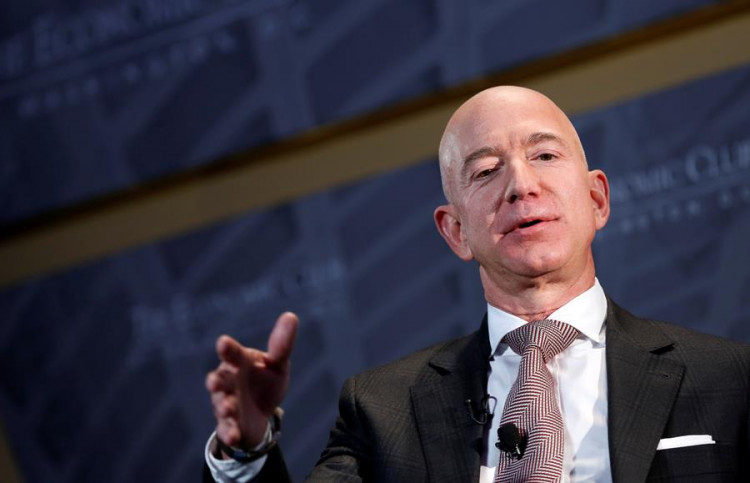
Jeff Bezos, the founder of Amazon and one of the world's wealthiest individuals with a fortune estimated at $221 billion, has long argued that anxiety stems less from overwork than from avoidance. His prescription, first articulated publicly in 2017, remains central to how he approaches leadership-and is increasingly echoed by other top executives navigating a high-pressure corporate climate in 2026.
"I find if I'm stressed about something, it's usually because I'm not doing anything about it," Bezos said in 2017. "I'm listening to my body as a signal that something is wrong, and I find that the stress goes away the second I take the first step."
Bezos' framing treats stress not as an affliction but as an early warning system. Rather than masking discomfort, he views it as a prompt to act-however minimally. The idea aligns with his broader leadership ethos: bias toward action, rapid experimentation and visible accountability.
The Amazon founder's career provides context for that philosophy. In the mid-1990s, he launched Amazon from a rented garage and attended 60 meetings to raise $1 million. The grind, by his telling, did not produce debilitating anxiety. What would have produced it, he suggests, was standing still.
Bezos has also emphasized collaborative problem-solving as a stress antidote. "If you can find friends who are interested in similar things or want to help you solve a problem, problem-solving is inspiring for me all by itself," he said. "There's nothing more fun than getting in a room with a group of inventors and saying, 'Look, here's the problem. Let's invent a solution to it.' And as soon as you start doing that, I find that it turns from something that might create stress into something that creates fun."
His thinking has influenced Amazon's leadership culture, even after he stepped aside as chief executive. In 2026, CEO Andy Jassy has described his approach as transforming Amazon from a "fortress" into what he calls the "world's largest startup," reinforcing a culture of agility and accountability.
Across corporate America, executives are articulating distinct stress-management doctrines:
- Satya Nadella, CEO of Microsoft: Emphasizes focus on "real-world impact" and open communication to mitigate burnout amid AI expansion.
- Andy Jassy, CEO of Amazon: Promotes "vocally self-critical" leadership to build trust and reduce internal pressure.
- Laxman Narasimhan, former CEO of Starbucks: Maintains "non-negotiables" including meditation, exercise and family time. "I'm very disciplined about balance," Narasimhan said in 2023.
- Damola Adamolekun, CEO of Red Lobster: Advocates measured responses under pressure. "Practising emotional control means taking a moment to pause, assess the situation, and respond thoughtfully, rather than reacting impulsively. When you model emotional control, you create a stable environment where your team feels supported and motivated, even in the face of adversity," he said.
The emphasis on emotional regulation and visible ownership reflects a shift in executive rhetoric. Jassy, for instance, has argued that trust is not about "being nice" but about being "vocally self-critical," signaling that transparency reduces the strain of concealment.
Meanwhile, Nadella has framed Microsoft's AI strategy as "AI as a scaffolding for human potential," aiming to prevent what some insiders describe as "model overhang"-the pressure to constantly outperform algorithms rather than collaborate with them.