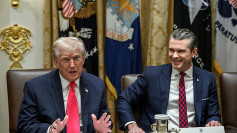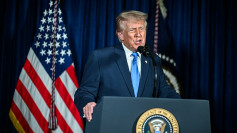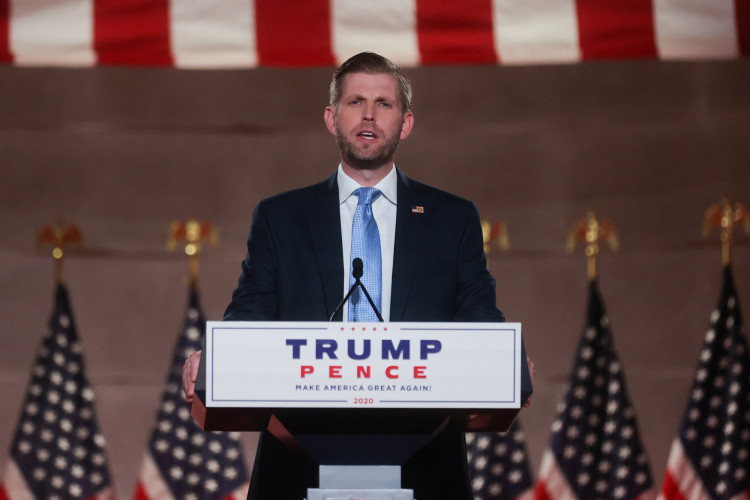
Donald Trump Jr. and Eric Trump have invested in a drone startup aiming to supply the Pentagon, a move that comes as the Trump administration reshapes the U.S. drone market through sweeping regulatory changes and expanded military procurement tied to escalating tensions with Iran.
On March 9, 2026, Aureus Greenway Holdings Inc. announced a merger with Autonomous Power Corporation, known as Powerus, a Florida-based defense technology firm founded by former U.S. Army Special Operations veterans. The transaction will combine the companies under the name Powerus Corporation and pursue a Nasdaq listing under the ticker PUSA. Both Trump sons hold stakes in Aureus Greenway through their investment vehicle American Ventures.
The merger is backed by a £7.1 million ($9 million) private placement involving investors including drone-components manufacturer Unusual Machines and a £39.5 million ($50 million) commitment from Seoul-based Korea Climate and Governance Improvement Fund. The financing brings total capital raised for the combined entity to roughly £46.6 million ($59 million).
Powerus was launched less than two years ago and has rapidly expanded through acquisitions aimed at positioning the company as a domestic supplier of military-grade drone systems. The company has acquired:
- Kaizen Aerospace, which manufactures heavy-lift unmanned aerial systems capable of carrying payloads exceeding 500 pounds
- Tandem Defense, focused on tactical military platforms
- Agile Autonomy, which develops maritime surveillance drone systems
All three subsidiaries operate from U.S.-based manufacturing facilities, aligning with federal policy encouraging domestic drone production. According to the company, Powerus is targeting manufacturing capacity exceeding 10,000 drones per month.
Matthew Saker, interim chief executive of Aureus Greenway Holdings, said in a statement that "the need for and uses of autonomous technologies are front page news given developments in the Middle East and elsewhere," adding that the merger was "made even more relevant by current geopolitical uncertainties."
The business case for companies like Powerus has strengthened sharply following regulatory action by U.S. authorities. On Dec. 22, 2025, the Federal Communications Commission added foreign-manufactured drones and critical components to its national security Covered List. The move effectively blocked new models from Chinese manufacturers-including DJI and Autel Robotics-from receiving FCC equipment authorization.
Those companies had previously controlled an estimated 70% to 90% of the U.S. consumer drone market. Without FCC authorization, new drone models cannot legally be imported, marketed or sold in the United States.
FCC Chairman Brendan Carr said the policy was designed to "unleash American drone dominance." DJI responded that the decision was "disappointing," stating that "no information has been released regarding what information was used by the Executive Branch in reaching its determination." China's foreign ministry described the designation as "discriminatory."
The regulatory shift has been reinforced by executive action from President Donald Trump's administration. On June 6, 2025, Trump signed Executive Order 14307, titled "Unleashing American Drone Dominance," directing federal agencies to prioritize U.S.-manufactured drone systems.
Defense Secretary Pete Hegseth expanded that directive with a Pentagon memorandum issued July 10, 2025. In the document, Hegseth wrote: "Drones are the biggest battlefield innovation in a generation," adding that "U.S. units are not outfitted with the lethal small drones the modern battlefield requires."
The Pentagon has since outlined plans to procure more than 200,000 drones by 2027, with projected spending of roughly £869 million ($1.1 billion) across four phases of procurement. Following initial evaluations at Fort Benning, Georgia, the Defense Department was preparing to place 30,000 drone orders in early 2026.
Donald Trump Jr.'s involvement in the sector predates the Powerus investment. In November 2024, weeks after his father won the presidential election, he joined Unusual Machines as an adviser despite, according to reporting by Popular Information, having "no notable experience with drones or military contracting." The advisory position granted him 200,000 company shares valued by multiple outlets at about £3.2 million ($4 million).
Unusual Machines later secured its largest Pentagon contract in October 2025, receiving a U.S. Army order for 3,500 drone motors with additional component orders expected. The company is also participating in the Powerus financing round, placing it in the position of both investor and potential supplier to the newly merged company.
The investment also unfolds against the backdrop of ongoing U.S. military operations in the Middle East. Since the United States and Israel launched strikes on Iranian nuclear facilities in mid-2025, Iran has conducted repeated drone and missile attacks across the region.
The New Republic reported on March 9 that a seventh U.S. service member had been killed after Iran struck a Saudi military base on March 1. The Pentagon had previously deployed its Low-Cost Unmanned Combat Attack System (LUCAS) drones to U.S. Central Command in November 2025, underscoring the growing reliance on unmanned systems in active combat operations.
Andrew Fox, chief executive of Powerus, told The Wall Street Journal that the drone sector's expansion is likely to outpace more traditional industries. "The drone market is certainly going to grow faster than, say, golf courses are," Fox said.
Ethics watchdogs have raised concerns about the overlap between government policy and private investments tied to the president's family. Kedric Payne, general counsel at the Campaign Legal Center, told Al Jazeera: "The first thing that comes to mind is another example of the president's family appearing to profit from the presidency."