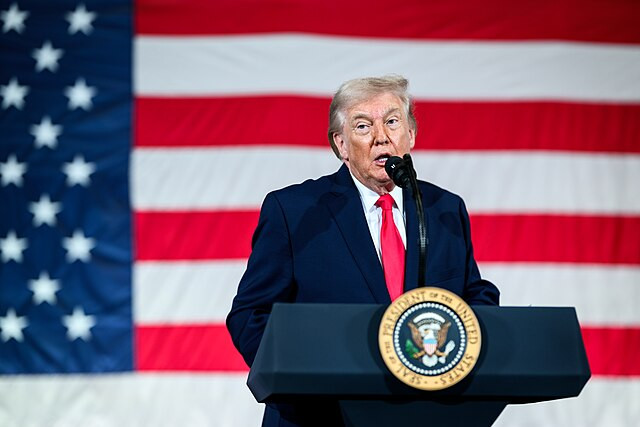
President Donald Trump said the United States is "totally destroying" Iran's regime militarily and economically, escalating his rhetoric about the ongoing war in the Middle East while sharply criticizing coverage by The New York Times and other media outlets that have reported a more complicated battlefield picture.
In a message posted Thursday on Truth Social, Trump described U.S. military operations against Iran as overwhelmingly successful, asserting that American forces have severely damaged the country's military capabilities.
"The United States is totally destroying Iran's regime," Trump wrote, adding that Iranian forces-including their naval and air capabilities-have been crippled.
Trump also claimed the U.S. military has overwhelming resources available for the campaign, stating the country possesses "unparalleled firepower, unlimited ammunition, and plenty of time."
The president's remarks come amid a rapidly expanding conflict involving U.S. and Israeli strikes on Iranian military infrastructure, retaliatory Iranian missile launches across the region, and growing concerns about disruptions to global oil supplies through the Strait of Hormuz.
Trump's social media post also targeted media coverage of the conflict, singling out The New York Times for what he described as inaccurate reporting.
He referred to the publication as the "Failing New York Times", accusing it of minimizing American military successes in the war.
The president did not cite a specific article. However, reporting from The New York Times and The Financial Times has suggested that while U.S. and allied forces have inflicted damage on Iranian infrastructure, the campaign has also faced operational challenges.
According to those reports, Iran has continued launching missiles and drones in retaliation despite sustained airstrikes.
The coverage also raised questions about the pace at which the U.S. military has been expending weapons during the early stages of the campaign.
The Financial Times reported that U.S. forces may have already used through "years" of munitions early in the conflict, highlighting concerns among defense analysts about the long-term sustainability of high-intensity operations.
Trump's comments contrast sharply with that reporting. In his Truth Social post, the president said Iranian leadership and military structures had been devastated, writing that they had been "wiped from the face of the earth."
Independent verification of those claims has not been publicly confirmed by U.S. defense officials or international monitoring groups.
What is confirmed is that Ayatollah Ali Khamenei, Iran's long-time supreme leader, was killed during the opening phase of the war in a joint U.S.-Israeli strike targeting senior Iranian leadership.
The strikes reportedly eliminated several high-ranking commanders and intelligence officials alongside the elder Khamenei, according to international reporting and Iranian state media acknowledgments.
Following his death, Iran's clerical leadership moved quickly to appoint his son, Mojtaba Khamenei, as the country's new supreme leader.
There have been conflicting reports about Mojtaba Khamenei's health following subsequent airstrikes, but no credible evidence suggests he has been killed. Iranian officials maintain that he remains alive and continues to lead the government.
Despite heavy strikes against Iranian infrastructure, the country's state apparatus remains operational. Iran has continued military responses across the region and has threatened shipping in the Strait of Hormuz, a critical maritime corridor for global oil exports.
Energy markets have closely monitored developments in the waterway, which normally handles roughly 20% of global oil shipments and a significant share of liquefied natural gas exports.
Commercial shipping traffic through the strait has dropped sharply during the conflict as insurers and shipping companies reassess risks associated with Iranian military activity and potential naval confrontations.
Trump framed the current campaign as part of a broader effort to confront what he described as decades of Iranian aggression.
In his Truth Social message, the president said Iran had been involved in violence against civilians worldwide and argued that his administration was addressing that threat during his term as the 47th president of the United States.