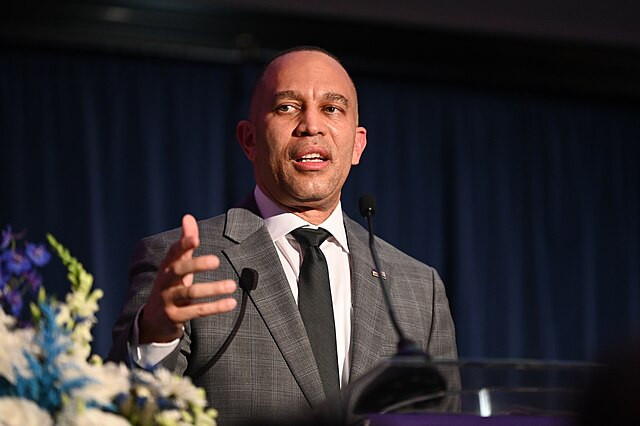
Hakeem Jeffries is moving to force a House vote on funding key parts of the Department of Homeland Security without including U.S. Immigration and Customs Enforcement or U.S. Customs and Border Protection, escalating a standoff that has left the department partially shuttered for more than a month.
The proposal, filed through a rarely used discharge petition, aims to bypass Republican leadership and bring a targeted funding bill directly to the House floor. The measure would provide funding for agencies including the Transportation Security Administration, Federal Emergency Management Agency and the U.S. Coast Guard, while withholding appropriations for ICE and CBP.
The move comes as the DHS funding lapse enters its fifth week, with more than 100,000 federal employees working without pay and operational strain mounting across airport security and disaster-response systems.
Democrats argue the targeted approach is necessary to stabilize essential services while continuing negotiations over immigration enforcement funding. Republicans have rejected that framework, insisting that DHS must be funded as a single, comprehensive package.
The legislative maneuver reflects a breakdown in the traditional appropriations process. Under standard procedure, funding bills move through committee review before reaching the House floor. A discharge petition allows lawmakers to circumvent leadership if 218 members sign on-an outcome that typically requires bipartisan support.
Jeffries and his allies are seeking to build that coalition, framing the proposal as a way to ensure continuity in critical public-facing services. The effort focuses on agencies with immediate impact on daily life, particularly air travel security and emergency response operations.
The operational consequences of the shutdown are becoming more visible:
- Over 100,000 DHS employees working without pay
- TSA staffing shortages contributing to longer airport lines
- FEMA response capacity stretched amid ongoing emergencies
The impasse traces back to disagreements over ICE and CBP funding levels and policy conditions, intensified by recent incidents involving immigration enforcement operations. Senate Democrats withdrew support for a broader DHS appropriations bill, triggering the current funding lapse.
Republican leaders have sharply criticized the discharge petition strategy, arguing that excluding ICE and CBP would undermine border security and enforcement capabilities. Some GOP lawmakers have characterized the approach as equivalent to weakening law enforcement functions.
Within the Democratic caucus, the strategy has exposed internal divisions. Some members support a full funding bill to restore pay and operations across DHS, while others insist that withholding funds from ICE and CBP is necessary to force policy changes.
The political calculus is complicated by the mechanics of the discharge petition itself. Democrats would need near-unanimous support within their caucus and at least a small number of Republican defections to reach the 218-signature threshold required to trigger a floor vote.