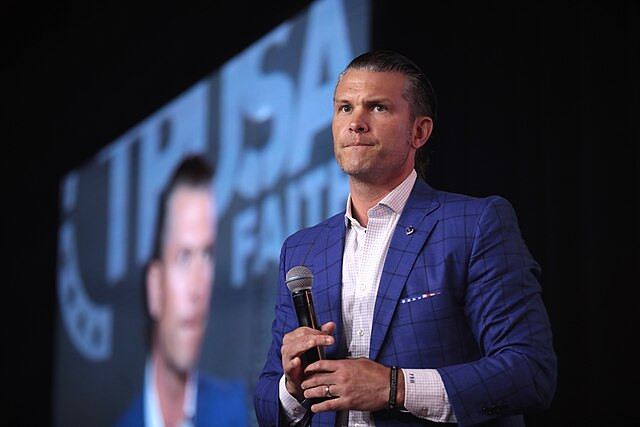
Fort Lesley J. McNair, Marco Rubio, Pete Hegseth and MacDill Air Force Base moved to the center of Washington's security concerns this week after unidentified drones were detected over the Army installation where the secretary of state and defense secretary live, prompting a White House meeting and renewed fears that the war with Iran may be producing a domestic security front.
The incident, first reported by The Washington Post and later matched by Reuters, occurred on a single night within the past 10 days over Fort McNair, one of the country's most tightly controlled pieces of airspace. Officials briefed on the matter said the drones' origin remains unknown, and the sightings were serious enough to prompt increased security measures and internal discussions about whether Rubio and Hegseth should be moved to another location. They were not relocated.
Fort McNair is not a routine residential address for political appointees. The base, in southwest Washington near the White House and Capitol Hill, houses the National Defense University and senior military personnel. Rubio and Hegseth live on the installation's "Generals Row," a historically military residential area that has increasingly been used to house top Trump administration officials because of heightened threat concerns, according to recent reporting.
The Pentagon declined to discuss the drone incident in detail. Chief Pentagon spokesman Sean Parnell said, "The department cannot comment on the secretary's movements for security reasons, and reporting on such movements is grossly irresponsible," according to The Washington Post account summarized by Reuters and other outlets. The State Department did not publicly answer questions about the episode.
The Fort McNair sightings did not occur in isolation. On March 18, MacDill Air Force Base in Tampa, home to U.S. Central Command, temporarily ordered personnel to shelter in place after what officials described as a threat against the installation. Days earlier, the FBI responded to a suspicious package outside the base visitor center. The bureau later said "possible energetic materials" were identified during field screening, though final lab analysis was still pending. MacDill has since operated under Force Protection Condition Charlie, the military's second-highest routine threat posture.
Those developments have unfolded against a wider U.S. security tightening linked to the Iran war. The State Department this week ordered all embassies and consulates worldwide to "immediately" review their security posture because of "the ongoing and developing situation in the Middle East and the potential for spill-over effects," according to internal reporting by The Washington Post and The Wall Street Journal. Posts were instructed to convene Emergency Action Committees to reassess threats and protective measures.
That directive suggests the administration is treating retaliation risks as broader than conventional battlefield exposure. Diplomatic facilities in the region have already curtailed operations, and security reviews have expanded worldwide as officials assess whether Iranian or Iran-linked actors could target U.S. personnel, facilities or high-profile officials outside the Middle East.
The McNair episode also lands in a country already uneasy about unidentified drone activity around sensitive sites. During the 2024 campaign, Secret Service agents encountered multiple drone incidents around Trump events, and previous administrations had extended security protection to former senior officials because of Iranian threats following the 2020 killing of Gen. Qasem Soleimani, according to prior reporting referenced in current coverage.
Several key facts remain unresolved, and they matter. Officials have not publicly identified the operators, the type of drones, whether they were commercial or more sophisticated systems, or whether the intrusion was surveillance, intimidation or something less organized. That uncertainty is precisely what makes the event more unsettling than a routine airspace violation: it exposed a vulnerability over a base housing two of the administration's most important national-security principals at a moment when U.S. officials are openly preparing for spillover from a widening regional war.