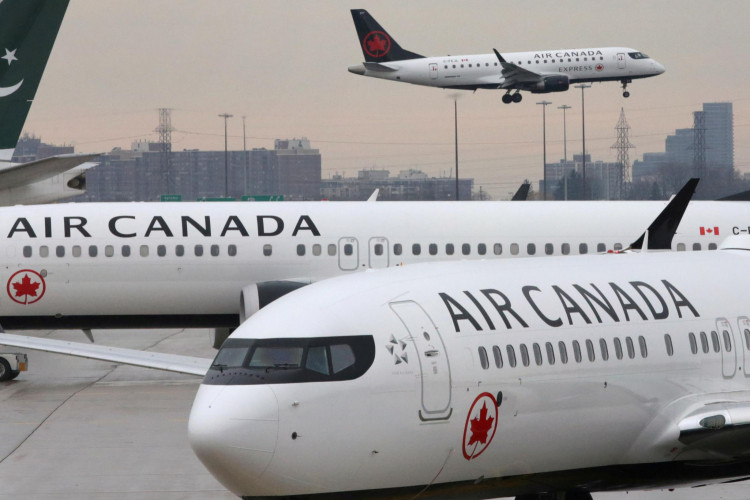
Two pilots aboard an Air Canada Express flight were killed late Sunday after their Bombardier CRJ-900 struck a Port Authority fire truck on a runway at New York's LaGuardia Airport, a collision that injured dozens of others, shut down one of the nation's busiest airports and immediately raised new questions about ground-control safety at a major U.S. hub. The source material says the aircraft, operated by Jazz Aviation and arriving from Montreal, was carrying 72 passengers and four crew members when it collided with the emergency vehicle on Runway 4 at about 11:38 p.m.
According to the provided account, the impact crushed the nose and cockpit area of Air Canada Express Flight 8646, killing the pilot and co-pilot. The article says 41 people were injured overall, including passengers, crew and personnel in the truck, and that LaGuardia was ordered closed through Monday afternoon as investigators and emergency crews secured the scene.
The collision occurred not during takeoff, but as the regional jet was slowing after landing. The source says preliminary flight-tracking data indicated the aircraft was moving at roughly 24 miles an hour when it hit the fire apparatus, identified as "Truck 1." That vehicle, according to the article, had been responding to a separate emergency involving a United Airlines flight that had reported an unidentified odor on board.
The account points to a possible communications breakdown in the seconds before impact. It says air-traffic-control audio indicated a controller had cleared Truck 1 to cross the runway before urgently trying to stop it moments before the collision. That sequence is now likely to sit at the center of the federal inquiry, because it suggests the accident may have resulted not from mechanical failure but from a fatal overlap in movement authority on an active runway.
The source also says two Port Authority officers inside the truck survived but were hospitalized with serious injuries, including broken limbs. Images described in the article show the jet pitched upward with the front galley and cockpit area destroyed, underscoring how concentrated the force of the impact was at the front of the aircraft.
Kathryn Garcia, identified in the material as executive director of the Port Authority of New York and New Jersey, said federal investigators had already been mobilized. "The National Transportation Safety Board will lead the inquiry into how these two paths intersected," Garcia said at a Monday morning press conference, according to the source. The article adds that nine people remained in serious condition even though most passengers were treated for less severe injuries.
The article says investigators are expected to examine whether staffing levels, visibility and broader operating conditions played a role. It notes the airport was functioning amid heavy rain and what it described as federal funding lapses affecting aviation staffing, framing the collision as more than an isolated runway mishap and instead as a possible test of a system operating with little room for error.
The provided material explicitly links the crash to a wider debate over aviation safety. It draws parallels to the November 2025 crash of UPS Flight 2976 in Louisville, which it says killed 15 people, and references a January 2025 near miss involving an American Airlines aircraft and a military helicopter. In both cases, the article argues, concerns about fatigue, oversight and strained safety systems were already on the table before the LaGuardia collision.
By Monday morning, the operational fallout had spread well beyond Queens. The source says the FAA imposed a ground stop for all departures to LaGuardia, while travelers were redirected to John F. Kennedy International Airport and Long Island MacArthur Airport. What began as a routine Montreal-to-New York regional flight has now become a test case for runway safety, emergency-vehicle coordination and the resilience of airport operations under pressure.