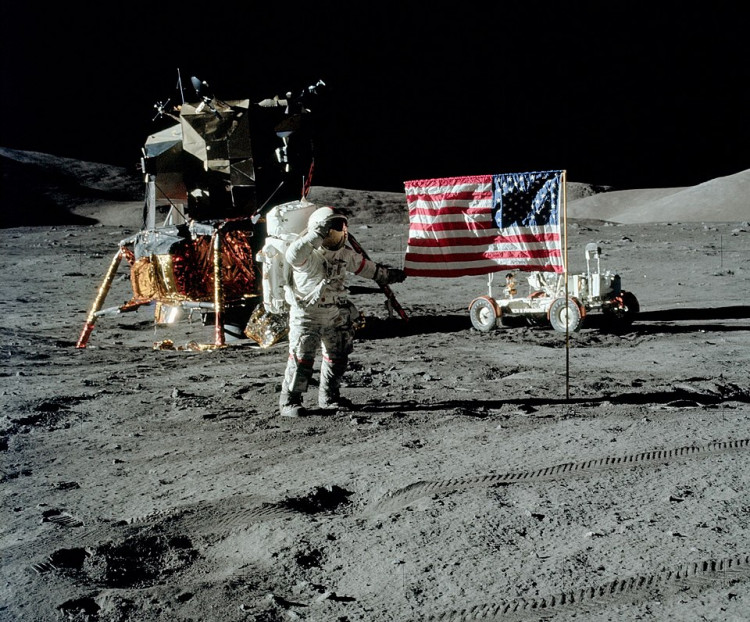
The final mission that put humans on the Moon is once again at the center of America's UFO debate after newly released Pentagon UAP files revealed a series of unexplained sightings reported by Apollo 17 astronauts during the December 1972 mission - alongside renewed claims that the crew may have received a warning from extraterrestrials to "never return."
The documents, released this month as part of the Trump administration's broader declassification push involving unidentified anomalous phenomena, include mission transcripts from NASA astronauts Eugene Cernan, Harrison Schmitt and Ronald Evans describing strange flashes, drifting particles and unexplained lights near the Moon during humanity's last crewed lunar landing.
Apollo 17 remains historically significant because it marked the final time astronauts walked on the lunar surface. Officially, NASA ended the Apollo program because of declining political support, mounting costs and shifting Cold War priorities. Yet the mission has long occupied a special place in UFO folklore, with conspiracy theorists arguing the United States abandoned lunar exploration after encountering something unknown.
The newly disclosed files have given those theories fresh momentum.
On the mission's first operational day, command module pilot Ronald Evans informed mission control that he could see "very bright particles or fragments" floating near the spacecraft. Lunar module pilot Harrison Schmitt compared the visual phenomenon to "the Fourth of July," describing flashes and drifting lights outside the vehicle.
The reports became more unusual as the mission progressed.
According to the transcripts, commander Eugene Cernan later described "sets of the streaks" accompanied by bursts of intense light that repeatedly crossed his field of vision. He compared one flash to the brightness of "a train headlight." Over several hours, the astronauts discussed rotating objects and unexplained luminous activity they struggled to identify with certainty.
At multiple points, the crew attempted to rationalize the sightings as debris from the Saturn V rocket or discarded mission hardware reflecting sunlight in space.
The Pentagon files stop well short of confirming extraterrestrial activity. One Apollo 17 image included in the release shows three bright lights arranged in a triangular formation above the lunar surface. Government analysts noted that "there is no consensus about the nature of the anomaly," while adding that a preliminary review suggested the feature "is potentially the result of a physical object in the scene."
The most controversial allegation, however, does not originate from the government documents themselves.
Japanese writer and NASA historian Takano Jousen, described in the material as a longtime friend of Eugene Cernan, now claims the Apollo 17 commander privately revealed that the crew received what he interpreted as a telepathic warning from extraterrestrials instructing humanity to "never return" to the Moon.
That claim has not been independently verified. Cernan, who died in 2017, never publicly made such allegations during his lifetime, and NASA has not acknowledged any evidence supporting the story.
Still, the timing of the disclosure has reignited public fascination because Apollo 17 effectively closed the chapter on crewed lunar exploration for more than five decades.
The Apollo material forms part of a much wider government release effort involving unidentified anomalous phenomena. The documents were published through coordination among the White House, the Office of the Director of National Intelligence, NASA, the Pentagon's All-domain Anomaly Resolution Office and the Department of Energy.
Donald Trump previously directed agencies to accelerate the declassification of UFO-related files, while Defense Secretary Pete Hegseth pledged "unprecedented transparency" surrounding unexplained aerial incidents.
Apollo 17 is not the only NASA mission now drawing renewed scrutiny.
The files also reference:
- Gemini VII in 1965, where astronaut Frank Borman reported a "bogey" near the spacecraft
- Apollo 11 observations involving unexplained flashes and luminous objects during the return from the Moon
- Apollo 12 accounts describing illuminated debris and unidentified particles drifting in space
In most cases, astronauts and engineers ultimately suggested conventional explanations ranging from detached spacecraft components to optical distortions caused by sunlight and reflections.
Even so, the release underscores how frequently highly trained NASA crews encountered phenomena they could not immediately explain during the early decades of human spaceflight.