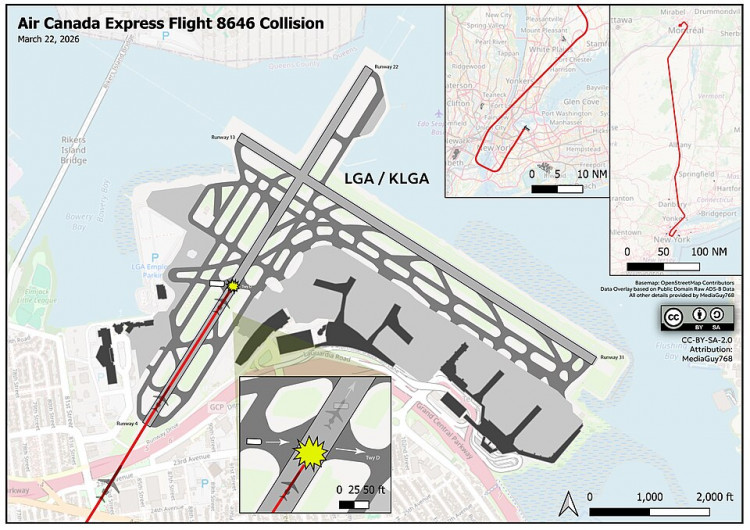
Two crew members were killed late Sunday when Air Canada Express Flight 8646, a Bombardier CRJ-900 arriving from Montreal with 72 passengers aboard, struck a Port Authority fire truck on Runway 4 at New York's LaGuardia Airport, turning an emergency response to another aircraft into a second, deadlier crisis.
The collision occurred shortly after 11:40 p.m. ET on March 22, after the fire truck had been cleared to cross the runway at taxiway Delta to respond to an unrelated emergency involving a United Airlines plane that had aborted takeoff because of a cabin odor. According to tower audio described in the article, an air traffic controller then urgently tried to reverse that instruction, repeating, "Stop, stop, stop," as the regional jet touched down and continued its landing roll.
Those final seconds now sit at the center of the investigation. Audio from the tower captured the controller first authorizing the crossing and then attempting to halt the vehicle, only for the sequence to collapse too quickly to prevent impact. Moments later, a voice on frequency said, "I messed up," an admission that framed the crash in blunt terms even before investigators arrived.
A Frontier Airlines pilot on the same frequency answered with a note of sympathy, saying the controller "did the best you could." But by then the CRJ-900 had already hit the truck. The article says the aircraft, slowing in misty conditions, tore into the vehicle, shearing off the cockpit and flipping the truck onto its side.
Kathryn Garcia, executive director of the Port Authority, confirmed that the truck had been dispatched to assist the United flight when the collision occurred. Images described in the article showed the plane's nose destroyed, cables hanging from the wreckage and the damaged front section tilted sharply backward.
Jazz Aviation, which operated the flight for Air Canada, said all 72 passengers survived. Still, the toll extended well beyond the two crew members who died. The article says 39 passengers were hospitalized, along with two Port Authority officers aboard the truck, both of whom suffered broken limbs and were reported stable.
The scale of the disruption spread across the airport within minutes. LaGuardia shut down completely after the crash, snarling operations at one of the country's busiest airports. Hundreds of flights were canceled overnight before the airport resumed operations at reduced capacity Monday afternoon.
Weather is likely to form part of the inquiry, though not the whole of it. Fog and mist had already disrupted operations earlier in the evening, and LaGuardia had posted warnings on X. Still, the central issue described in the article is more specific: how an emergency vehicle responding to one incident ended up crossing an active runway just as a landing aircraft rolled through.
The National Transportation Safety Board moved quickly, dispatching investigators to examine the air-traffic decisions, runway movements and cockpit records. Emergency responders cut through the aircraft's roof within hours to recover the black boxes. Preliminary information cited in the article indicates the plane had already landed and was decelerating when the truck crossed in front of it.
No mechanical problem has yet been identified in the account provided. Investigators are expected to focus instead on timing, visibility, controller instructions and cockpit awareness. The cockpit voice recorder and flight data recorder are expected to help determine whether any warning reached the pilots in time to alter the outcome.