President Donald Trump's remarks about receiving a "present" from Iran during an Oval Office exchange have triggered renewed scrutiny of his communication style and mental fitness, as the United States navigates escalating tensions with Tehran.
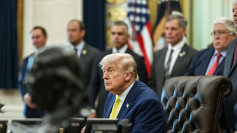
Speaking to reporters, Trump made an unexpected claim about recent developments in the conflict. "They did something yesterday that was amazing actually. They gave us a present. The present arrived today. It was a very big present worth a tremendous amount of money," he said, offering no further context.
Pressed for clarification, Trump declined to elaborate. "I'm not going to tell you what that present is, but it was a very significant prize," he added, leaving both reporters and officials uncertain about the meaning behind the statement.
The comments quickly circulated in Washington and beyond, with some officials reportedly struggling to interpret the reference amid a volatile geopolitical backdrop. The United States and Iran remain engaged in a high-stakes confrontation, making the notion of a "gift" particularly difficult to reconcile with the broader context.
Iranian state media responded by airing a video that appeared to mock Trump's remarks, amplifying the moment internationally. The reaction underscored how quickly ambiguous statements can shape narratives during periods of diplomatic and military tension.
The episode was followed by a series of social media posts from Trump in which he shifted rapidly between political targets, including Texas politician James Talarico and California Governor Gavin Newsom. Observers noted the abrupt transitions and tone as part of a broader pattern in his recent public communications.
The remarks have prompted commentary from medical professionals, though experts emphasized the limits of remote assessment. Dr. Vin Gupta said the situation raises legitimate questions while cautioning against definitive conclusions. "There are multiple data points here that are worrisome when it comes to Trump's health," Gupta said.
Gupta pointed to what he described as patterns including "wandering thoughts" and difficulty maintaining a consistent line of communication. At the same time, he stressed that clinical diagnosis requires direct evaluation. "We're asking questions," he said. "You cannot diagnose someone without a physical exam."