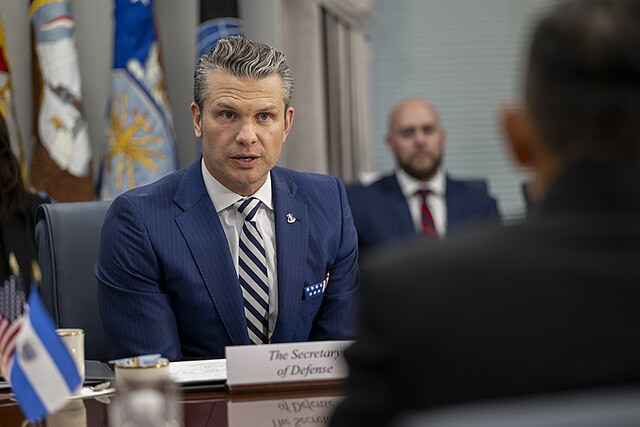
Pete Hegseth is facing mounting scrutiny after calling for "overwhelming violence" against enemies during a livestreamed prayer service at the Pentagon, intensifying debate over the role of religion in U.S. military leadership as the conflict involving Iran expands.
Speaking before civilian staff and uniformed personnel, Hegseth framed the moment in stark terms tied to ongoing military operations. "Let every round find its mark against the enemies of righteousness and our great nation," he said during the prayer. "Give them wisdom in every decision, endurance for the trial ahead, unbreakable unity, and overwhelming violence of action against those who deserve no mercy."
He followed with a biblical passage, stating: "I pursued my enemies and overtook them, and did not turn back till they were consumed." The remarks were delivered as tens of thousands of U.S. personnel remain engaged in operations connected to the Iran conflict.
The language has drawn criticism from legal and academic observers who argue it blurs lines between personal faith and official authority. Ronit Stahl, a historian at the University of California, Berkeley, noted that religious references in public life are longstanding, but said the explicit framing in this context marks a shift in tone.
The controversy has quickly moved beyond rhetoric into legal action. Americans United for Separation of Church and State filed a lawsuit challenging the Pentagon services and similar events at other federal agencies, arguing that such gatherings risk imposing religious views within government institutions.
Rachel Laser, the group's president, said in a statement: "Secretaries Hegseth and Chavez-DeRemer are abusing the power of their government positions and taxpayer-funded resources to impose their preferred religion on federal workers."
The Pentagon has not provided detailed responses to questions about the services or their broader policy implications. The legal challenge is expected to focus on whether participation is truly voluntary within a hierarchical environment such as the military.
Hegseth's remarks also coincide with proposed structural changes to the military chaplaincy. His plan includes reducing recognized religious affiliations from more than 200 to 31 and shifting chaplains' roles toward spiritual guidance rather than what he described as "self-help and self-care."
The changes would also alter how chaplains present themselves, removing visible military rank from uniforms in favor of religious insignia. Supporters argue the move could make chaplains more approachable, while critics warn it risks narrowing representation within a diverse force.
Historical precedent has been cited by defenders of Hegseth's approach. References to religion have long existed within the U.S. military, including presidential support for chaplaincy programs and the distribution of religious materials to troops during wartime.
However, critics argue the current moment differs in both tone and context, particularly given the explicit invocation of faith in operational language. Hegseth has previously encouraged Americans to pray for troops "in the name of Jesus Christ," reinforcing what some view as a more assertive expression of religious identity in official settings.