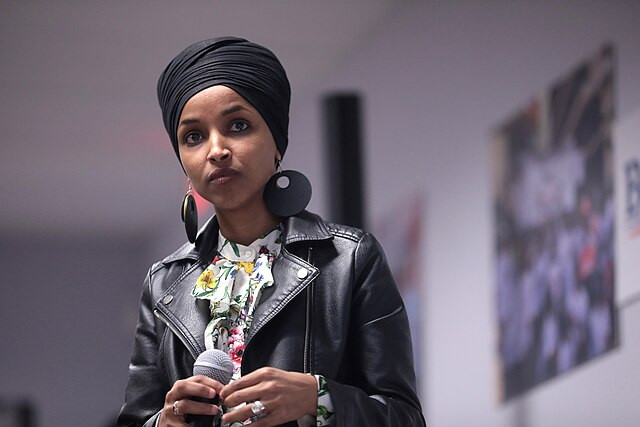
A false claim that Rep. Ilhan Omar could be deported to Somaliland spread rapidly across U.S. media and social platforms this week, after an unverified X account was mistakenly treated as an official government source following remarks by Vice President JD Vance about potential legal action.
The episode underscores how quickly political rhetoric, online misinformation, and media amplification can converge into a widely accepted narrative before verification catches up.
The controversy began with a post from an account identifying itself as @RepOfSomaliland, which appeared to respond to deportation speculation with provocative language: "Deportation? Please you're just sending the princess back to her kingdom. Extradition? Say the word ..."
Several major outlets-including Fox News, the New York Post, Sinclair Broadcast Group's National News Desk, and the Independent-initially reported the statement as if it reflected Somaliland's official position. Somaliland authorities had previously warned that such accounts are unauthorized and do not represent government policy.
By Monday, Somaliland's foreign ministry reiterated that only "official and authorised channels" should be treated as credible sources, effectively disavowing the viral post. Fox News later amended its reporting, reclassifying the account as a "Pro-Somaliland account" rather than an official government voice.
The misinformation gained traction against the backdrop of remarks made by Vance in a March 28 interview on "The Benny Show," hosted by influencer Benny Johnson. Vance alleged that Omar had "definitely committed immigration fraud against the United States of America."
He added, "We're trying to figure out what the legal remedies are," describing ongoing discussions with White House immigration adviser Stephen Miller about possible next steps to "get some justice for the American people."
Pressed on whether deportation or denaturalization was legally viable, Vance did not provide a specific pathway. Omar's office issued a sharp rebuttal. Her chief of staff Connor McNutt called the allegations "a ridiculous lie and desperate attempt to distract," while also noting Vance's past admission of a willingness to "create stories" to redirect attention.
The rapid spread of the claim reflects a recurring pattern in politically charged misinformation. Analysts note that viral narratives often combine a kernel of real political rhetoric with fabricated or misattributed content, creating a more plausible-yet misleading-storyline.
For Omar, such episodes are not isolated. The Minnesota Democrat, who was born in Somalia and became a U.S. citizen as a teenager, has repeatedly been the subject of viral claims tied to her background. In 2024, a mistranslated speech circulated widely, falsely portraying her as declaring allegiance to Somalia over the United States.
The current controversy also intersects with heightened political rhetoric. President Donald Trump recently described Somalia as a "crooked, disgusting country" and stated he would get Minnesota "back from Somalia," language that critics argue contributes to the amplification of identity-based narratives.
Advocacy groups have warned about the broader implications. Jaylani Hussein, executive director of the Minnesota chapter of the Council on American-Islamic Relations, said portraying an entire population in such terms "is not just political rhetoric - it is dehumanisation."