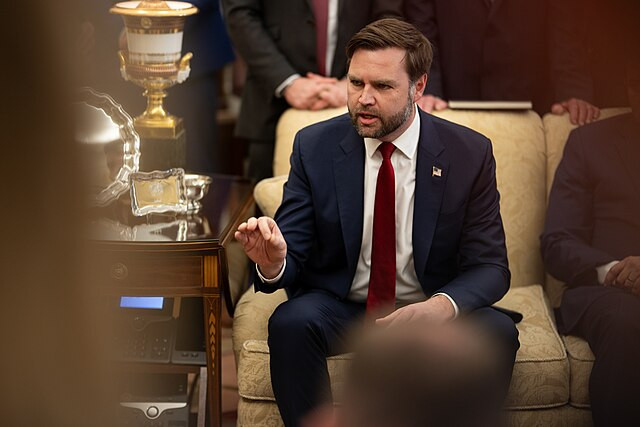
Vice President JD Vance drew widespread criticism after remarks in Budapest linking nuclear negotiations with Iran to a personal anecdote about his wife, comments that quickly circulated online and intensified scrutiny of his role in U.S. foreign policy messaging.
Speaking to reporters at Budapest Ferenc Liszt International Airport following meetings with Hungarian officials, Vance addressed ongoing talks with Iranian leaders, including discussions surrounding uranium enrichment. His comments came during a broader trip in which he appeared alongside Viktor Orbán ahead of Hungary's upcoming election.
Vance initially struck a measured tone on negotiations, saying, "We're going in the right direction, but it's going to take a little time," before recounting a remark from Iranian parliamentary speaker Mohammad Bagher Ghalibaf: "The second thing Ghalibaf said, which again, I found fascinating, he said, 'We refuse to give up the right to enrichment.'"
He then introduced a comparison that became the focal point of the backlash. "My wife has the right to skydive, but she doesn't jump out of an airplane because she and I have an agreement that she's not going to do that, because I don't want my wife jumping out of an airplane," Vance said.
The vice president framed the analogy as a way to distinguish between theoretical rights and practical constraints in diplomacy. He added, "We don't really concern ourselves with what they claim they have the right to do. We concern ourselves with what they actually do, and I think the president's been very clear on the enrichment question. Our position on that has not changed."
The remarks were broadcast by C-SPAN and rapidly disseminated across social media platforms, where critics characterized the analogy as ill-suited to the gravity of nuclear negotiations. One user wrote, "Global affairs aren't your marital agreements." Another commented, "There is tying oneself into a verbal pretzel, and then there is this."
The episode unfolded against a politically sensitive backdrop. Vance's visit to Hungary had already drawn attention for its overt support of Orbán, a nationalist leader whose policies have strained relations with the European Union. Critics argued that the appearance blurred longstanding diplomatic norms around U.S. involvement in foreign elections.
During the trip, Vance also criticized European institutions, accusing Brussels of "disgraceful" interference and claiming the EU sought to "hold down" Hungarian voters. Those remarks reinforced his emerging profile as a leading voice in shaping the administration's foreign policy posture.
Analysts say the controversy underscores the challenges of communicating complex national security issues to a broader audience. While analogies are often used to simplify policy debates, misalignment between tone and subject matter can amplify scrutiny, particularly when discussions involve nuclear capabilities and geopolitical risk.
Supporters of the administration have framed the comments as an attempt to make abstract policy disputes more accessible. Critics, however, argue that the analogy risks trivializing a central issue in U.S.-Iran relations, where enrichment limits remain a core point of contention in negotiations.