Donald Trump ordered a sweeping maritime blockade targeting Iranian ports in the Strait of Hormuz, asserting that Iran's naval forces had been effectively destroyed, even as global energy markets braced for disruption across one of the world's most critical oil transit routes.
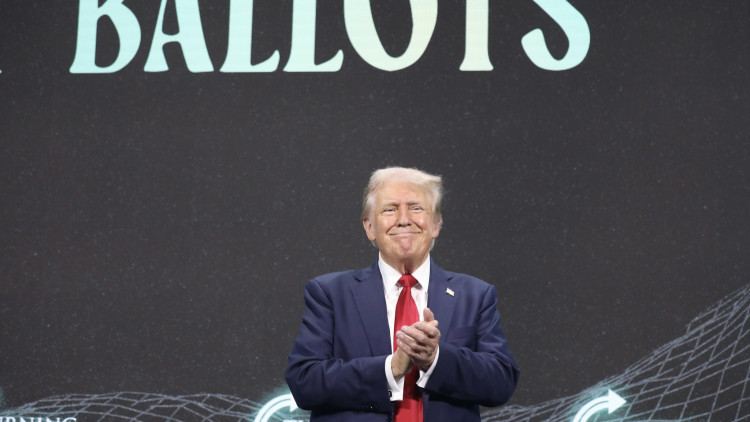
Speaking at Joint Base Andrews, Trump claimed the Iranian military had suffered catastrophic losses, stating: "I would say it's holding well. Their military is destroyed, their whole navy is underwater. One hundred fifty ships are gone, their navy is gone." The remarks came as a 10 a.m. Eastern deadline for enforcement of the blockade took effect.
There has been no independent verification of the claim that 150 Iranian naval vessels are "underwater," and neither U.S. Central Command nor Pentagon officials have publicly confirmed comparable figures. The absence of corroboration has left analysts cautious about assessing the scale of any damage to Iran's fleet.
Trump nonetheless doubled down on his assessment of Tehran's position. "I think Iran is in very bad shape. I think they're pretty desperate," he said, adding that U.S. officials had held a 21-hour meeting on the crisis and now "understand the situation better than anybody." When asked about renewed diplomacy, he signaled little urgency: "I don't care if they come back or not. If they don't come back, I'm fine."
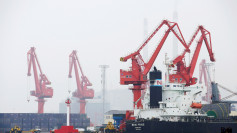
The blockade itself represents a significant escalation. According to U.S. Central Command, forces will stop "all maritime traffic entering and exiting Iranian ports," while emphasizing that operations would be applied "impartially" across vessels regardless of nationality. At the same time, CENTCOM said it "will not impede freedom of navigation for vessels transiting the Strait of Hormuz to and from non-Iranian ports," an attempt to limit broader commercial disruption.
The stakes for global markets are substantial. Roughly 21% of the world's daily oil supply passes through the narrow corridor, making any sustained disruption a potential shock to energy prices and inflation. Financial centers from London to New York have reacted with heightened volatility as traders assess the risk of prolonged supply constraints.
Allied governments have responded cautiously. Trump said in a Fox News interview that the U.K. and "a couple of other countries" were sending minesweepers, though reporting from Sky News indicated London is not formally joining the blockade. A U.K. government spokesperson said: "We continue to support freedom of navigation and the opening of the Strait of Hormuz, which is urgently needed to support the global economy and the cost of living back home."
The spokesperson added: "The Strait of Hormuz must not be subject to tolling. We are urgently working with France and other partners to put together a wide coalition to protect freedom of navigation," signaling a preference for multilateral maritime security rather than direct enforcement of a blockade.
Iranian officials responded with sharp warnings. The naval arm of the Islamic Revolutionary Guard Corps said any military vessels enforcing the blockade would be considered in violation of the ceasefire and would face a "strong and forceful response." Senior adviser Mohsen Rezaee dismissed the U.S. strategy outright, writing: "America, just as it suffered a historic defeat against Iran in failing to open the Strait of Hormuz, is also doomed to failure in its maritime blockade."
Iran's navy commander Shahram Irani echoed that stance, calling the blockade threat "ridiculous and laughable" and asserting that Washington had already suffered a "humiliating defeat." The rhetoric underscores the widening gap between U.S. claims of dominance and Iran's insistence that it retains significant leverage in the region.