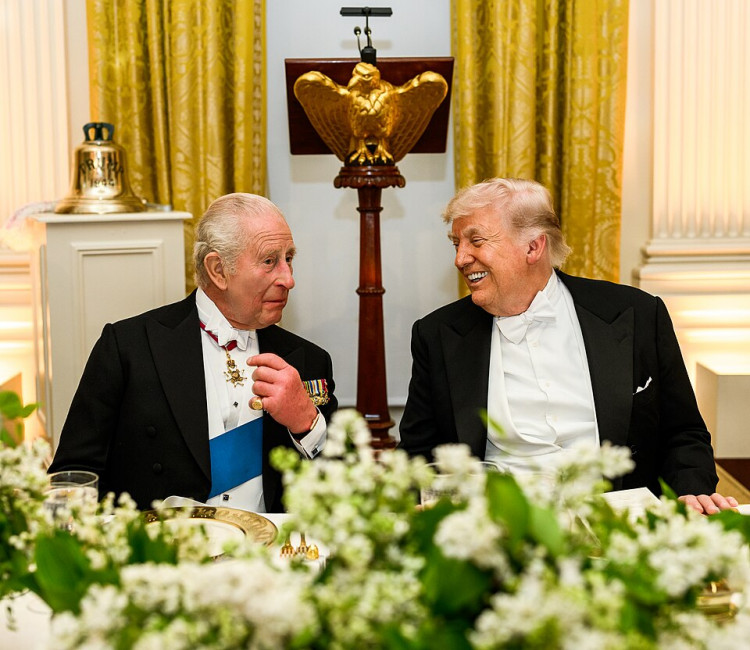
King Charles III and Donald Trump presented a notably cordial front during the monarch's recent state visit to the United States, with palace officials emphasizing a "warm" relationship even as longstanding claims of private tensions resurfaced alongside the trip.
Senior aides described the interactions between the British royals and the U.S. leadership as unexpectedly smooth, despite a backdrop of policy disagreements and prior criticisms. One palace aide told GBN that Trump "got on very well" with the King and Queen Camilla, adding that the rapport extended across both couples, including Melania Trump.
"They get on very well. And it's not just the King and the President. It's all four of them with each other," the aide said, characterizing the visit as a diplomatic success. Another official acknowledged that the broader political climate could have made the engagement "tricky," but insisted, "But far from it."
The visit, which included a White House meeting, a state dinner and a congressional address, was framed by palace officials as a calculated exercise in soft-power diplomacy. "What looked like risk and challenge was also a phenomenal opportunity. One that was grasped in both hands by the King," the aide added.
Public remarks from Trump reinforced that tone. He described Charles as a "fantastic person" following their meeting, while photographs from the trip showed the two leaders appearing relaxed during joint appearances. Palace insiders later reiterated that "the warmth that you see in public is absolutely the warmth you see in private."
Yet the optics of personal rapport contrasted with the content of Charles's speech to U.S. lawmakers, which some observers interpreted as a subtle assertion of traditional alliances. In his address, the King urged continued support for Ukraine and NATO, aligning with longstanding British foreign policy positions that Trump has previously questioned.
The speech included historical references and a pointed moment of humor. Responding to a claim Trump had made about World War II, Charles remarked: "Dare I say that, if it weren't for us, you'd be speaking French." According to palace accounts, the address drew 12 standing ovations.
Critics and commentators saw the remarks as more than ceremonial. The combination of constitutional references, defense of alliances, and historical framing was interpreted by some as a measured but deliberate signal of divergence on geopolitical priorities.
Complicating the narrative further are longstanding claims about the King's private views. Royal author Tina Brown previously asserted that Charles "viscerally despises" Trump, citing disagreements over NATO and Western alliances. Those claims have not been confirmed by Buckingham Palace.
Officials instead emphasized the constitutional role of the monarch. "The King is there to support the government, to help the government. It was at the government's request, of course, that he undertook this visit," a palace aide said, underscoring that the trip served broader diplomatic objectives rather than personal alignment.
Moments of ambiguity persisted during the visit. At a state dinner, Trump suggested Charles shared his stance on Iran, saying, "Charles agrees with me even more than I do." Buckingham Palace later indicated the position reflected the U.K.'s established policy on nuclear non-proliferation but did not directly address Trump's broader characterization.
The trip concluded with Trump announcing the removal of tariffs on whisky imports, describing it as a concession influenced by the royal visit. "Got me to do something that nobody else was able to do, without hardly even asking," he said, framing the outcome as evidence of the visit's effectiveness.