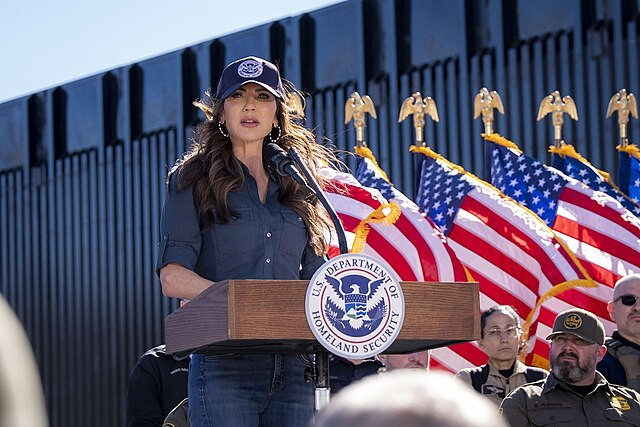
The Department of Homeland Security's inspector general has launched a formal audit into nearly $1 billion in warehouse acquisitions tied to former DHS Secretary Kristi Noem, intensifying scrutiny of a sweeping immigration detention expansion programme that purchased properties lacking basic infrastructure, zoning approvals and operational readiness.
The review, confirmed by the DHS Office of Inspector General to The Wall Street Journal, targets 11 vacant commercial warehouses acquired by U.S. Immigration and Customs Enforcement during a rapid buying spree last winter. The properties were intended to become large-scale detention centres under a broader federal initiative funded through Republicans' "One Big Beautiful Bill."
"DHS OIG can confirm this audit was announced recently," a spokesperson told The Wall Street Journal. "However, as a matter of course, we do not provide any additional information publicly on the scale or scope of our ongoing work."
The detention expansion plan, formally known as the ICE Detention Reengineering Initiative, envisioned converting commercial warehouse space into facilities capable of holding more than 92,000 detainees nationwide. Congress allocated roughly $38.3 billion for the effort, according to federal documents and reporting surrounding the programme.
But months after the acquisitions, none of the facilities are operational.
Several properties reportedly lack working plumbing systems or proper detention zoning permits, while others are tied up in lawsuits, environmental reviews or state-level legal challenges. The stalled rollout has raised mounting questions inside Washington about whether federal officials rushed the purchases without conducting sufficient due diligence.
Commercial real estate data reviewed by analytics firm CoStar suggested ICE paid significantly above prevailing market rates for many of the buildings.
According to CoStar's analysis:
- ICE allegedly paid between 11% and 13% above market value on the first 10 properties acquired.
- Estimated taxpayer overpayments totaled roughly $107 million.
- A Salt Lake City warehouse purchased for $145.4 million carried a 2025 assessed value of only $97 million.
The Salt Lake transaction has become one of the most scrutinized examples in the programme.
The 833,000-square-foot facility reportedly cost ICE nearly 50% above its tax-assessed valuation. Comparable industrial properties in the same region sold for materially lower prices, including a one-million-square-foot warehouse purchased by Walmart for $112 million, according to CoStar records cited in reporting by Building Salt Lake.
One local broker described ICE's reported $174-per-square-foot purchase price as "unheard of."
The controversy extends beyond the real estate transactions themselves.
The Wall Street Journal reported that nearly 50 contractors collectively received approximately $1.7 billion in federal contracts linked to the warehouse initiative since January 2025. Several firms reportedly had no prior experience operating immigration detention facilities, while four companies had never previously held federal contracts before receiving awards tied to the programme.
Some contracts were reportedly worth as much as $500 million combined.
The GEO Group executive chairman George Zoley publicly questioned the operational practicality of converting warehouses into detention sites.
"As far as the physical plant renovations of a warehouse to get it operational, it's complicated, and then the operational implications of how you manage such a facility, particularly a large-scale facility, is going to be concerning," Zoley told investors in February.
The legal resistance surrounding the facilities has grown steadily across multiple states.
In Arizona, the state attorney general sued in April to block construction tied to a $70 million detention conversion project in Surprise. In Maryland, a judge paused work on a $102 million facility pending environmental review requirements. In New Jersey, litigation filed this week halted another proposed warehouse conversion project in Roxbury Township over alleged violations of the National Environmental Policy Act.
The political fallout has also widened inside DHS itself.
Markwayne Mullin, who replaced Noem after President Donald Trump dismissed her in March, reportedly paused the broader warehouse initiative shortly after taking office. While construction efforts have slowed, the already-purchased properties remain federal assets and are now central to the inspector general's inquiry.
Investigators are reportedly examining additional issues tied to Noem's tenure, including a separate $220 million taxpayer-funded advertising campaign and allegations involving former adviser Corey Lewandowski. Reports allege Lewandowski sought payments from contractors in exchange for safeguarding federal business relationships, though no formal findings have yet been released publicly.