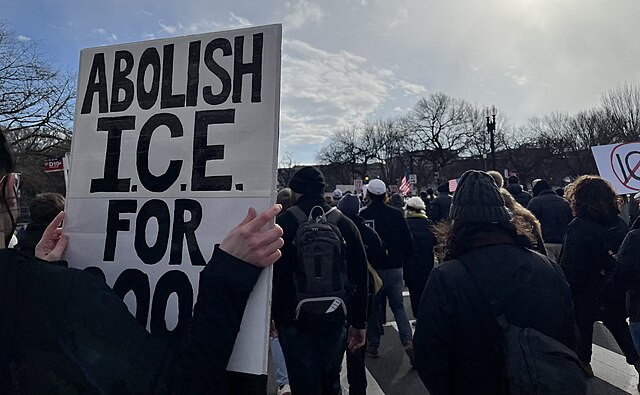
A Minnesota prosecutor has charged a federal immigration agent with multiple felony counts tied to a Minneapolis shooting during a Trump administration enforcement operation, escalating a growing legal and political battle over federal authority, immigration raids and accountability for officers operating under aggressive deportation policies.
Mary Moriarty announced Monday that ICE agent Christian Castro faces four counts of second-degree assault and one count of making a false crime report stemming from a January incident inside a Minneapolis residence during Operation Metro Surge, a large-scale federal immigration crackdown that sparked protests, lawsuits and multiple investigations across Minnesota.
"Mr. Castro is an ICE agent, but his federal badge does not make him immune from state charges for his criminal conduct in Minnesota," Moriarty said during a press conference. "I've said it many times and I'll say it again: there is no such thing as absolute immunity for federal officers who commit crimes in this state or any other."
The charges represent a rare instance of a state prosecutor bringing criminal counts against a federal immigration officer tied to actions taken during official enforcement operations. The case is expected to test the legal boundaries between federal authority and state criminal jurisdiction.
The shooting victim, Julio Cesar Sosa-Celis, survived after being shot in the leg during the operation. Authorities later acknowledged federal agents had entered the residence searching for a different individual altogether.
The incident quickly became one of the most controversial episodes connected to Operation Metro Surge, an enforcement campaign launched amid the Trump administration's intensified immigration crackdown in the Midwest. The operation ultimately drew scrutiny after several residents were injured and two U.S. citizens were killed during separate encounters involving federal agents.
Federal officials themselves later began questioning the original account provided by officers.
In February, acting ICE director Todd Lyons disclosed that the Justice Department had opened an investigation into two federal officers tied to the Minneapolis shooting. According to Lyons, an internal review concluded that "sworn testimony provided by two separate officers appears to have made untruthful statements."
That finding dramatically undercut the initial narrative advanced by senior Department of Homeland Security officials, including then-DHS Secretary Kristi Noem, who had defended the officers and claimed an agent "fired a defensive shot to defend his life."
Federal authorities also accused Sosa-Celis and his roommate, Alfredo Aljorna, of participating in "an attempted murder" of federal agents.
Those allegations later collapsed in court.
A federal judge permanently dismissed the case against both men after prosecutors admitted "newly discovered evidence" contradicted the original accusations. Moriarty said Monday that investigators conducted an extensive review with assistance from the Minnesota Bureau of Criminal Apprehension before deciding to file state charges.
She also confirmed that Sosa-Celis was legally present in the United States at the time of the shooting.
The case now appears headed toward a broader jurisdictional battle. Moriarty said Castro's legal team is expected to attempt to move proceedings into federal court, a common strategy used by federal officials accused of crimes connected to their official duties.
Even if that transfer succeeds, Moriarty stressed that Hennepin County prosecutors would continue handling the underlying criminal case. She also noted that because the prosecution originates at the state level, Castro would not qualify for a presidential pardon if convicted.
The fallout surrounding Operation Metro Surge has widened well beyond Castro.
Last month, Moriarty's office also charged another federal immigration officer, Gregory Donnell Morgan Jr., with assault after authorities alleged he pointed a firearm at motorists while driving along a highway shoulder during the same enforcement operation.
Meanwhile, Minnesota officials have continued pressing the Trump administration for greater transparency surrounding the crackdown. In March, the state filed legal action seeking investigative records tied to the Minneapolis shooting and the deaths of Minnesota residents Alex Pretti and Renee Good, both killed during encounters involving federal agents.