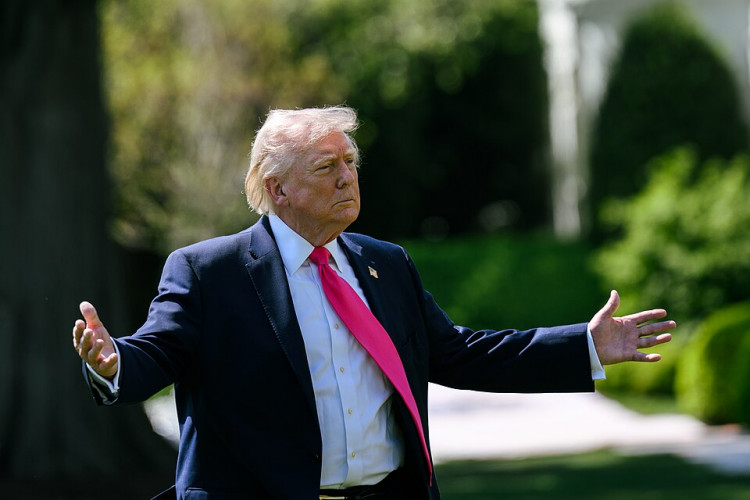
Donald Trump appeared in public Wednesday with his visibly bruised and swollen right hand heavily covered in beige concealer, reigniting scrutiny over the president's health just hours after a lengthy and at times disjointed commencement address at the United States Coast Guard Academy.
Photographs captured by Reuters photographer Evelyn Hockstein at Joint Base Andrews showed Trump's dominant hand appearing puffy and discolored beneath thick cosmetic coverage, particularly around the knuckles and fingers. The images quickly circulated online and renewed questions that have shadowed several recent public appearances by the 79-year-old president.
The White House again attributed the bruising to Trump's frequent handshaking and his use of daily aspirin, though officials did not directly address the visible swelling or why concealer appeared to have been applied so heavily.
White House spokesperson Davis Ingle defended the president in comments to the Daily Beast, saying: "President Trump is the sharpest, most accessible, and energetic president in American history. The President is a man of the people and he meets more Americans and shakes their hands on a daily basis than any other President in history. President Trump's commitment is unwavering and he proves that every single day."
The administration has repeatedly pointed to Trump's own earlier disclosure that he takes 325 milligrams of aspirin daily, which he previously described to The Wall Street Journal as "good for thinning out the blood." Medical experts have long noted that aspirin can increase bruising risk because it affects clotting, though the White House has released no detailed medical assessment explaining the recurring discoloration visible on both of Trump's hands in recent months.
The latest appearance drew particular attention because the concealer coverage appeared more extensive than during Trump's recent visit to Beijing, where patchier makeup around his wrist and knuckles fueled similar online speculation.
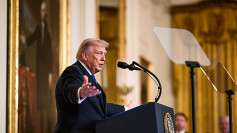
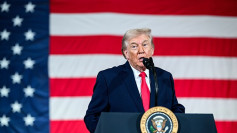
The hand controversy unfolded against the backdrop of Trump's commencement speech in New London, where he addressed graduating Coast Guard cadets in remarks that frequently drifted from military themes into campaign-style political rhetoric.
Standing before cadets in dress uniform, Trump praised what he described as renewed American confidence while also attacking political opponents and offering loosely connected motivational advice.
"Our national slengtheses is back," Trump declared at one point, apparently attempting to say "strength." The unusual phrasing and slightly slurred delivery quickly became another focal point of online discussion surrounding the speech.
He later added: "We are a confident country again. We have confidence back."
The president also delivered several meandering passages that mixed warnings about adversity with calls for ambition.
"Things will happen, and I believe, for the best, hopefully for the best, but I believe for the best. But things will happen that you can't even imagine," Trump told the cadets before abruptly shifting tone and saying: "And it's gonna be very exciting, but the way that's going to happen is through thinking big."
At another point, Trump appeared to lose the thread of his remarks while discussing perseverance and momentum.
"Nothing great was ever built. Think of that," he said. "Nothing great was ever built without the word momentum at your side. In times of your life, you'll have momentum. That's the time you go forward."
The speech itself largely followed Trump's now-familiar campaign-era rhetorical style, blending military ceremony with political grievance and improvised motivational language. But the visual focus surrounding the president increasingly centered less on the substance of his remarks and more on his physical appearance.