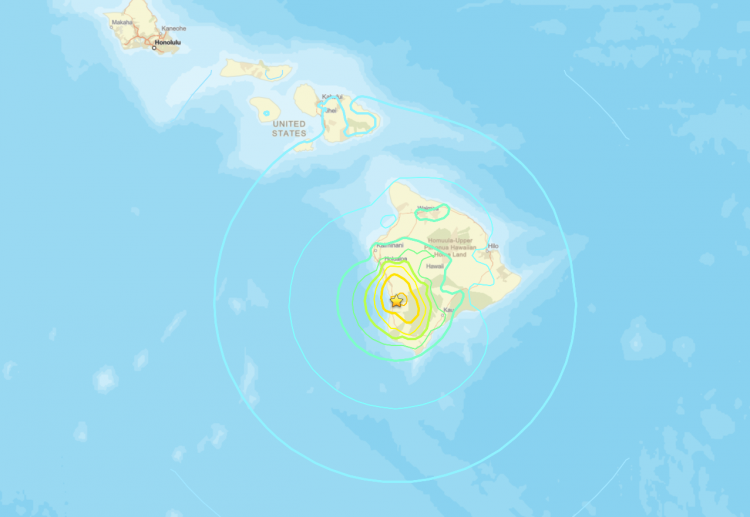
A powerful magnitude 6.0 earthquake struck near Mauna Loa on Hawaii's Big Island late Friday night, rattling communities across the island chain, triggering rockslides and briefly sparking fears of a volcanic eruption and tsunami before federal and state officials moved quickly to reassure residents that neither threat had materialized.
The tremor hit at 9:46 p.m. local time on the western flank of Mauna Loa, according to the United States Geological Survey. The quake was centered roughly seven miles south of Honaunau-Napoopoo and about 22 miles south-southeast of Kailua-Kona at a depth of approximately 14 miles.
Scientists initially measured the earthquake at magnitude 5.9 before upgrading it to 6.0 following additional analysis. The event immediately revived anxieties in Hawaii, where seismic activity near Mauna Loa - the world's largest active volcano - often raises public fears about lava flows, evacuations and tsunami risk.
Officials from the Pacific Tsunami Warning Center quickly confirmed that the earthquake did not generate a tsunami. Authorities also stressed there were no signs the quake had triggered volcanic activity at either Mauna Loa or nearby Kilauea.
'USGS scientists were blunt in their assessment of any link between the quake and Mauna Loa's volcanic systems,' according to statements released after the event. 'The earthquake had no apparent impact on either Mauna Loa or Kilauea volcanoes.'
The agency added that the quake was 'not directly related to volcanic processes.'
Instead, researchers said the seismic event appeared tied to the immense geological stress created by the weight of the Hawaiian Islands pressing down on the Pacific tectonic plate.
'The depth, location, and recorded seismic waves of the earthquake suggest that it was caused by stress due to bending of the oceanic plate from the weight of the Hawaiian island chain,' the USGS stated.
The shaking was still intense enough to cause localized disruptions. Hawaii police said large rocks and debris fell onto Napoopoo Road during the quake, forcing officials to close both lanes between the 10-mile marker and Middle Keei Road while crews cleared the area overnight.
Residents across multiple islands reported feeling the shaking, including on Oahu, Maui and Kauai. Within an hour, more than 2,600 people had submitted reports through the USGS "Did You Feel It?" system, describing strong vibrations, rattling walls and falling household items.
USGS categorized the tremor as "strong to very strong" in parts of the Big Island, warning that light to moderate structural damage was possible in affected communities.
Emergency officials began checking for:
- Cracked roads and infrastructure
- Minor structural damage to buildings
- Fallen debris along steep hillside routes
- Utility disruptions in isolated areas
There were no immediate reports of serious injuries or large-scale destruction.
Several aftershocks followed in the hours after the initial quake. The largest early aftershock measured magnitude 3.2 and struck around 9:52 p.m. near the same western flank region of Mauna Loa.
Scientists warned additional aftershocks remain possible in coming days, though they said future tremors are 'unlikely to be large enough to be felt or cause damage.'
The earthquake revived memories of Mauna Loa's most recent eruption in late 2022, when lava flows and seismic activity drew global attention to volcanic hazards across Hawaii. That eruption, though ultimately contained, reinforced how quickly concern can spread whenever strong seismic activity strikes near the volcano.
Officials appeared determined Friday night to separate scientific reality from online speculation. Rumors about an imminent eruption spread rapidly across social media shortly after the quake, prompting repeated statements from state agencies clarifying that there was no evidence magma movement had intensified beneath Mauna Loa.