Nvidia CEO Jensen Huang is doubling down on his belief that artificial intelligence will create more jobs than it eliminates, even as new workforce data shows tens of thousands of technology employees have lost their positions during a year marked by aggressive AI adoption across corporate America.
Speaking at Computex 2026 in Taipei, Huang rejected the increasingly common argument that AI is driving widespread unemployment among software engineers and other technology professionals. The remarks came as companies across the industry continue restructuring operations around artificial intelligence tools and automation.
"People talk about AI reducing jobs. Complete nonsense. It's causing more software engineers to be hired," Huang said during Nvidia's GPU Technology Conference.
The comments highlight a growing divide between technology executives promoting AI's economic potential and labor market data showing significant workforce reductions at some of the industry's largest employers.
Huang argued that AI is dramatically increasing the productivity of software developers rather than replacing them. According to the Nvidia chief executive, engineers equipped with AI tools can now generate output equivalent to multiple workers, creating incentives for companies to expand hiring rather than reduce headcount.
"The number of engineers, software engineers, is actually increasing," Huang said. He added that roughly 30 million to 40 million software developers worldwide are benefiting from AI-assisted productivity gains.
"If that line were flat, then obviously people will hire fewer software engineers. But because the output is so incredible, people want to hire more," Huang said.
The billionaire executive has been making similar arguments for more than a year. At the ServiceNow Knowledge 2026 conference, Huang said "AI is doing nothing but create jobs." Earlier this year, he argued that critics often confuse a job's purpose with its individual tasks.
"We need a trillion lines of code written," Huang said in May, maintaining that demand for software development continues to expand even as AI automates portions of coding work.
His position echoes remarks he delivered at the Milken Institute Global Conference in 2025, where he warned workers that adaptation-not replacement-would define the AI era.
"You're not going to lose your job to an AI, but you're going to lose your job to someone who uses AI," Huang said at the time. He also predicted that "100% of everybody's jobs will be changed."
Yet workforce figures cited by Layoffhedge paint a more complicated picture. According to the data, 172,130 employees have lost jobs across 47 technology companies so far in 2026, with 107,775 of those cuts attributed to AI-driven restructuring and automation initiatives.
Several major technology firms have announced substantial workforce reductions:
- Accenture: 11,000 job cuts
- Oracle: 30,000 planned reductions globally
- Meta: 16,000 layoffs
- Amazon: 16,000 layoffs
- Dell: 11,000 positions eliminated, representing 10.2% of its workforce
- Microsoft: 8,750 planned cuts
- Cisco: 4,000 planned reductions
The layoffs come as companies invest heavily in AI infrastructure, automation software and machine-learning systems designed to improve efficiency and reduce operating costs.
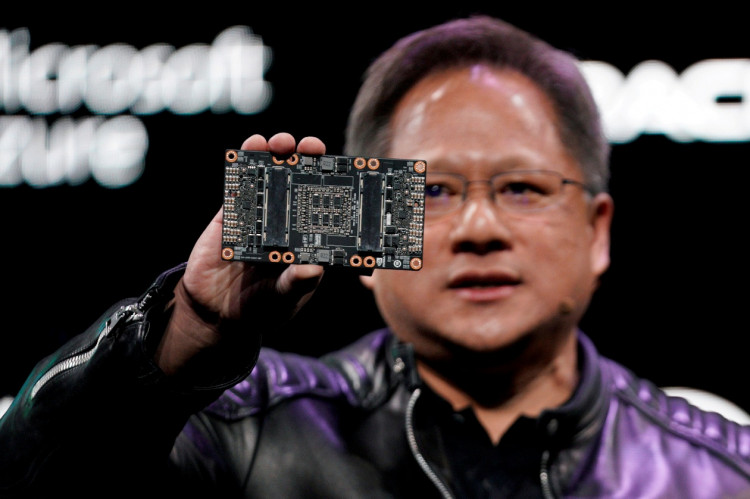
Huang remains one of the most influential voices in the AI economy. Nvidia, whose chips power much of the world's AI development, recently became the world's most valuable company with a market capitalization of approximately $5.4 trillion. During Computex, Huang also unveiled the RTX Spark, a new Nvidia-Microsoft superchip that he described as a major step forward for personal computing.