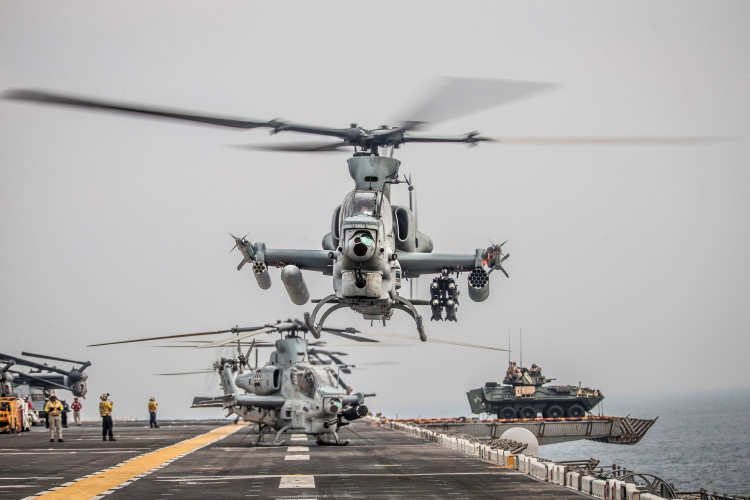
Fresh military exchanges between the United States and Iran have reignited tensions across the Middle East, with new attacks in the Strait of Hormuz and Bahrain threatening to unravel a fragile ceasefire agreement reached earlier this month. The latest violence has intensified concerns over the security of one of the world's most critical shipping lanes as Washington and Tehran continue negotiations over maritime access and Iran's nuclear program.
The renewed confrontation unfolded after Iranian drone strikes targeted Bahrain and a commercial vessel transiting the Strait of Hormuz on Saturday, according to reports from the Associated Press and Reuters. The attacks came hours after U.S. forces carried out overnight strikes against Iranian military positions, marking another escalation in a conflict that has repeatedly spilled into the strategically vital Gulf region.
The United Kingdom Maritime Trade Operations center confirmed that a vessel was attacked while passing through the Strait of Hormuz. Although no group immediately claimed responsibility, the incident occurred amid heightened hostilities following renewed exchanges between the United States and Iran. Maritime officials said the ship's crew remained safe and reported no environmental damage.
President Donald Trump accused Iran on Friday of violating the ceasefire by launching attacks against commercial shipping. Trump said Iran's military "shot at least four One Way Attack Drones at Ships transversing the Strait of Hormuz," describing the action as a "foolish violation" of the agreement. According to the administration, U.S. airstrikes were conducted after an earlier Iranian drone attack on a vessel attempting to exit the waterway on Thursday.
The U.S. military said its latest operation targeted Iranian missile and drone facilities as well as coastal radar installations. The strikes reportedly focused on surveillance infrastructure along Iran's southern coastline that Washington said supported recent attacks against commercial shipping.
Vice President JD Vance, who has led U.S. negotiations with Tehran, urged Iran to resolve disputes through diplomacy rather than military action. In earlier remarks following renewed hostilities, Vance said Tehran should "pick up the phone" if it had concerns about implementing the ceasefire agreement, adding that "violence will be met with violence."
At the center of the dispute remains the Strait of Hormuz, a narrow maritime corridor through which roughly one-fifth of the world's energy supplies moved before the conflict erupted. Iran has repeatedly argued that vessels passing through the waterway must comply with its directives and has sought to impose transit fees on commercial shipping. Washington has consistently rejected that position, maintaining that international shipping routes must remain open without additional charges.
Secretary of State Marco Rubio reinforced that position during a Gulf Cooperation Council meeting in Bahrain earlier this week. Warning against Iranian efforts to impose fees on vessels using the Strait of Hormuz, Rubio declared, "International waterways do not belong to any nation-state."
Following reports of attacks on commercial shipping, the Joint Maritime Information Center, overseen by the U.S. Navy, announced that shipping routes near Oman's coastline were being expanded to accommodate both inbound and outbound commercial traffic. The adjustment was widely viewed as an effort to reduce congestion and improve maritime security following repeated incidents in the region.
Iran also acknowledged carrying out drone strikes against Bahrain, saying the attacks targeted facilities linked to U.S. forces stationed in the kingdom. A statement from Iran's Foreign Ministry did not identify the specific locations but said Iranian forces struck several locations "of the U.S. terrorist army in the region." According to Reuters, Tehran characterized the operation as retaliation for recent American airstrikes against its coastal surveillance facilities.
Bahrain's Foreign Ministry condemned the attacks, saying "a number of Iranian drones" targeted the country and describing the operation as "a flagrant threat to the security of citizens and residents." Bahrain has frequently found itself caught in the regional rivalry with Iran, partly because it hosts the U.S. Navy's Fifth Fleet.