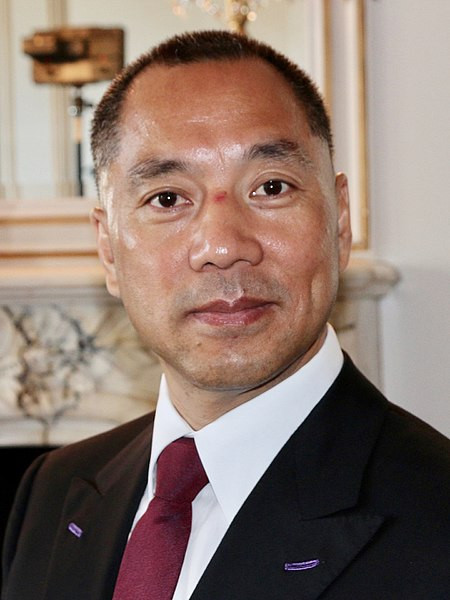
Chinese billionaire Guo Wengui, also known as Miles Guo, Ho Wan Kwok and Miles Kwok, was sentenced Monday to 30 years in federal prison after a New York judge concluded he orchestrated a sweeping fraud scheme that prosecutors said siphoned more than $1 billion from followers who believed they were supporting both investment opportunities and a movement opposing the Chinese Communist Party.
U.S. District Judge Analisa Torres also ordered Guo to forfeit $889 million, capping one of the largest financial fraud prosecutions involving a Chinese exile in the United States. The sentencing followed a jury's 2024 conviction on nine of 12 criminal counts, including wire fraud, securities fraud, bank fraud and money laundering, after prosecutors argued he deceived thousands of supporters over several years.
Judge Torres delivered a blunt assessment of the case during the hearing.
According to The Associated Press, the judge said Guo had "preyed on those seeking to bring democracy to China," taking investors' money to finance an extravagant lifestyle while causing losses totaling hundreds of millions of dollars to more than 1,000 victims worldwide. She also said Guo continued to deny responsibility, insisting "incredibly" that his conduct caused no financial harm despite the evidence presented at trial.
The court also heard emotional testimony from victims whose savings disappeared after investing in Guo's businesses.
Wei Chen, who testified during the trial, told the court that Guo's fraud "destroyed my life" and devastated her family. According to court proceedings, Chen accumulated roughly $1 million in debt after investing in media and cryptocurrency ventures promoted by Guo that prosecutors described as fraudulent.
Federal prosecutors portrayed Guo as a businessman who transformed his political following into a fundraising network.
After arriving in the United States around 2015, Guo built a large online audience by presenting himself as an outspoken critic of China's Communist Party and establishing nonprofit organizations promoting democracy. Prosecutors argued that instead of delivering promised investment returns, he diverted investor money to finance what court filings described as "a lifestyle of extraordinary excess and indulgence, a gilded life of mansions, yachts, race cars, designer clothes and luxury furnishings."
Authorities said those purchases included:
- A $37 million yacht.
- A $26 million mansion in New Jersey.
- A luxury apartment overlooking Central Park.
- Designer furnishings and luxury goods, including two mattresses reportedly costing $36,000 each.
Judge Torres echoed prosecutors' position during sentencing.
"Mr Guo intended to deceive his victims and take their money for his own financial gain," she said before imposing the sentence. The judge also criticized what she described as Guo's lack of remorse, adding that he had "called upon supporters to harass and intimidate those who dare to speak out against him."
Despite the conviction, Guo continued to command a devoted following.
More than 250 supporters filled the courtroom and overflow rooms during Monday's hearing, while more than 600 victims submitted written statements before sentencing. Some supporters insisted Guo was being politically persecuted because of his criticism of Beijing.
One supporter, Shawy Miles, told the New York Post, "He wanted to take down the Communist Party, that is why he is here. He is being set up. All the evidence was false. It's set up, it's a trap by the CCP!" Another supporter, Shu Pingfeng, described Guo as "our hero" and praised his campaign for "freedom and democracy and rule of law for Chinese people in China."
Guo himself maintained that narrative during his remarks before the court.
"The reason I came to the U.S. was to destroy the CCP," he told a courtroom filled with supporters, referring to the Chinese Communist Party. Guo also told the court he intends to appeal his conviction. Earlier in the day, proceedings were delayed after he claimed he had fainted in detention, vomited blood and received medical attention before being transported to court.
Defense attorneys argued Guo had long been targeted by the Chinese government, describing him in court filings as the victim of the Chinese Communist Party's "grand, pervasive, and life threatening" campaign against him. Throughout the proceedings, Guo continued to portray himself as an exiled whistleblower exposing corruption within China's political leadership rather than a financial fraudster.
The case also renewed attention on Guo's political connections in the United States. He was closely associated with former White House adviser Steve Bannon, who was arrested aboard Guo's yacht in a separate federal fraud investigation in 2020. President Donald Trump later pardoned Bannon in 2021, though Guo never received a presidential pardon despite speculation from some observers that he might seek one.
China reacted quickly to Monday's sentencing. The country's Ministry of Foreign Affairs said it had taken note of the verdict and reiterated that Guo remains a wanted fugitive subject to an Interpol Red Notice requested by the Chinese government. Meanwhile, federal prosecutors argued the criminal case centered not on Guo's political views but on a years-long scheme that they said exploited loyal followers who believed they were investing in both financial opportunities and a broader pro-democracy movement.