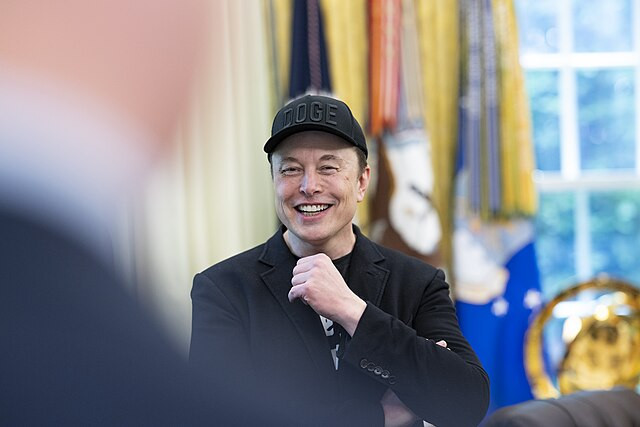
Elon Musk is predicting a rapid transformation at SpaceX, telling employees that artificial intelligence could generate more revenue than all of the company's other businesses combined as soon as September and eventually account for 99% of its value, an extraordinary shift for a company built around rockets, satellites and Starlink connectivity.
The near-term forecast sets a measurable test for Musk's expanding AI strategy. SpaceX reported $7.81 billion in second-quarter revenue, with AI accounting for $2.56 billion, compared with $4.29 billion from connectivity and $962 million from space products.
That means SpaceX's non-AI businesses generated roughly $5.25 billion during the quarter. Assuming those operations remain around that level, AI revenue would need to more than double from its second-quarter figure to exceed the rest of the company.
Musk told employees that he expects that crossover to happen by September and said AI revenue should "significantly" exceed SpaceX's other revenue sources during the fourth quarter. The timetable is unusually aggressive even by Musk's standards and would make AI a central driver of SpaceX's financial performance within months.
The company's identity has already begun changing. SpaceX acquired Musk's xAI operation before its June listing, bringing the Grok artificial-intelligence business under the same corporate umbrella as Starlink and SpaceX's aerospace operations.
The combination gives Musk an unusual collection of assets: launch infrastructure, a global satellite network, artificial-intelligence models and plans for massive computing capacity. If his projections prove accurate, rockets and communications satellites could increasingly function as infrastructure supporting a much larger AI enterprise rather than serving as SpaceX's principal source of value.
Musk has outlined plans for 10 gigawatts of AI computing capacity by the end of next year, an enormous expansion that he has suggested could eventually support hundreds of billions of dollars in annual revenue. Those projections remain targets rather than established financial results.
His longer-term valuation forecast is more dramatic. Musk told employees that AI could represent 99% of SpaceX's value within four or five years, leaving the company's launch, spacecraft and satellite-connectivity businesses responsible for only a fraction of its overall valuation despite their continuing operational importance.
Space itself could become part of that computing strategy. Musk has discussed deploying AI computing infrastructure in orbit, where systems could potentially draw heavily on solar energy while avoiding some of the power and land constraints confronting terrestrial data centers.
Turning that idea into a commercially competitive computing network would involve significant engineering and economic hurdles. Hardware would have to be launched, operated and potentially replaced in space, while communications, cooling, reliability and cost would all determine whether orbital computing can compete with increasingly large data centers on Earth.
Musk is also looking inside SpaceX for material that could improve Grok. During the employee meeting, he said the AI system would be trained on the "totality" of SpaceX information and described the approach as effectively training the technology on the people working at the company.
SpaceX hasn't publicly detailed what employee information could be included, how it would be collected or what controls workers might have over its use. Those unanswered questions could become more significant as internal company knowledge plays a larger role in the development of commercial AI systems.