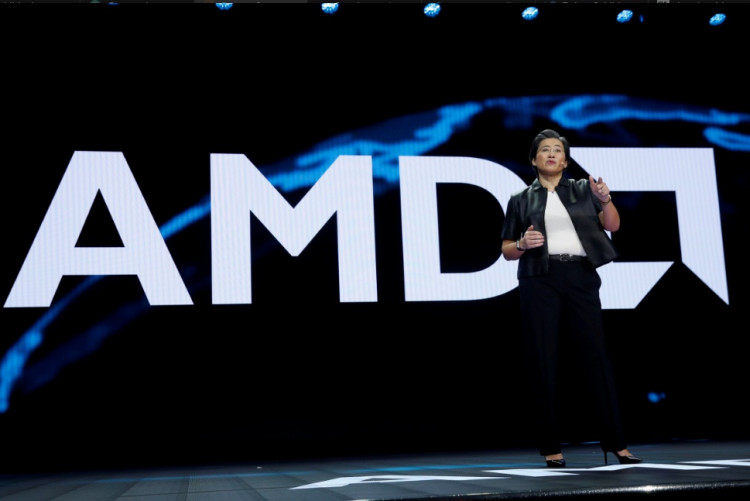
Advanced Micro Devices surpassed $1 trillion in market capitalization for the first time Monday, joining a small group of technology companies whose valuations have been propelled by Wall Street's enthusiasm for artificial intelligence. The milestone followed a five-session rally that lifted AMD shares roughly 24%, as investors increased their bets on the chipmaker's expanding data center business.
AMD stock climbed about 10% during Monday's trading session, rising above $613.92 and briefly pushing the company's valuation past the trillion-dollar threshold. The advance sent shares to a record high and extended a recovery from the volatility that followed AMD's second-quarter earnings announcement in August.
The rally reflects growing investor expectations that AMD will capture a larger share of the market for processors used to train and operate advanced AI models. Its shares have risen more than 180% this year, making the company one of the prominent beneficiaries of the continued expansion of artificial intelligence infrastructure.
AMD's latest quarterly results have reinforced those expectations. The company reported second-quarter revenue of $11.54 billion, up 50% from $7.69 billion a year earlier, as demand for its processors and AI-related products accelerated.
Its data center division accounted for much of that growth. Quarterly revenue from the business reached $6.7 billion, a 107% increase from the previous year, underscoring the growing importance of AI accelerators and server processors to AMD's financial performance.
The company is competing with Nvidia for a greater share of spending by cloud providers and other operators building large-scale AI systems. Although Nvidia remains substantially larger, AMD's expanding range of AI accelerators and server processors has given customers another supplier as demand for computing capacity increases.
The latest advance also highlights the change in AMD's position within the semiconductor industry. Its market capitalization has expanded rapidly as investors have placed greater value on companies supplying the infrastructure behind AI applications, rather than focusing primarily on traditional personal-computer chips.
AMD Chief Executive Lisa Su has indicated that the company expects further expansion. During its August earnings call, she said AMD anticipated doubling its data center revenue in 2027, a forecast that would make the business an even larger contributor to the company's overall sales.
The industry's investment outlook remains closely tied to spending by major technology companies on increasingly powerful AI models. Demand extends beyond the processors used to train those models to the hardware required to operate them as businesses and consumers adopt AI-powered services.
Nvidia Chief Executive Jensen Huang reinforced expectations of continued growth last week, saying he expected his company to double the number of chips it sells next year. His forecast points to substantial anticipated demand across the market, even as Nvidia and AMD compete for customers and computing workloads.
The investment surge has also raised questions about the costs of expanding AI infrastructure. New data centers require substantial electricity supplies, and proposed facilities have encountered opposition in some communities. Debate over AI safety has introduced another source of uncertainty for companies investing in the technology.
Those concerns have not prevented semiconductor stocks from attracting renewed investor interest. AMD's advance coincided with a broader rally in chipmakers Monday, when Intel and Arm Holdings also posted substantial gains and the Philadelphia Semiconductor Index climbed more than 4%.
AMD's second-quarter results illustrate the scale of the shift toward data center products. The division generated approximately 58% of the company's quarterly revenue, compared with a business mix historically more dependent on personal computers and gaming hardware.