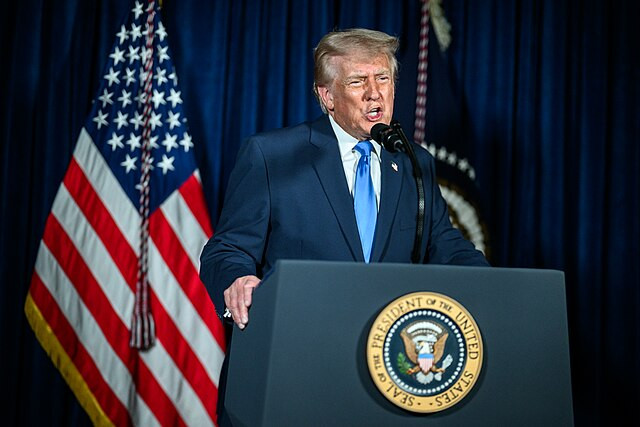
President Donald Trump said the United States could become a "big money machine" by cutting off trade with countries that run large surpluses with America, drawing criticism from economists and commentators as Washington's trade confrontation with Canada enters a new phase of tariffs and retaliation.
Speaking in the Oval Office on Monday, Trump argued that if a country makes $40 billion a year from trade with the U.S., Washington could effectively save that amount by ending the relationship. His comments came days after trade negotiations with Ottawa collapsed and the U.S. imposed 50% tariffs on roughly $20 billion of Canadian imports.
"You take certain countries, I don't want to mention any, but countries that you consider great, and they're paying a half a point," Trump said.
"But they make $40 billion a year with the United States. If they don't make the 40 billion ... so we cut off trade with that country, we just made $40 billion, and you do a few countries like that and we become a big money machine."
The remarks quickly generated criticism because trade balances don't translate directly into government revenue or savings. When Americans stop importing goods from one country, consumers and businesses often shift purchases elsewhere, while tariffs can increase costs for products that continue entering the U.S.
Trump began the Oval Office exchange by criticizing the Federal Reserve, saying the U.S. should have "the lowest interest rates in the world." He then shifted to trade, presenting reduced imports as a way to retain more money inside the country.
The latest figures show how much more protectionist U.S. trade policy has become. The Tax Foundation estimates that tariffs now cover 54% of U.S. goods imports in 2026, with the effective tariff rate reaching 7.2%, up sharply from 1.5% in 2022.
Online reaction to Trump's comments was sharply negative. One X user wrote, "This guy's brain is gone," while others described the argument as "incredibly stupid" and "imbecilic."
Another user mocked the logic by writing: "I stopped trading with my grocery store and saved $600 a month but also I starved to death." A separate post said: "This is the type of thinking that bankrupted casinos."
Trump did not mention Canada by name during the remarks, but his comments came amid a rapidly escalating dispute with Ottawa. The administration imposed 50% tariffs on about $20 billion of Canadian imports under a rarely used Depression-era law after negotiations broke down in late August.
Canadian Prime Minister Mark Carney responded by pledging "dollar for dollar" retaliation beginning Sept. 8. Ottawa's measures are expected to target U.S. steel, dairy products, electronics and appliances, putting pressure on American exporters that rely heavily on the Canadian market.
Trump has accused Canada of "ripping us off for decades" and has defended the tariffs as a response to what he says are discriminatory Canadian policies affecting U.S. autos, alcohol and dairy products.
The economic relationship is large enough that the dispute carries broader consequences. Bilateral trade in goods and services totaled about $880 billion last year, making Canada the second-largest U.S. trading partner.
The new American tariffs cover about 5% of Canada's exports to the U.S., while Ottawa's planned retaliation is aimed at a roughly comparable value of American goods. That leaves companies on both sides facing higher costs and greater uncertainty over supply chains.
Treasury Secretary Scott Bessent has resisted describing the confrontation as a trade war. In an interview with CNBC, he said the U.S. is not in a "trade war" with Canada even as the two governments prepare matching tariff measures.