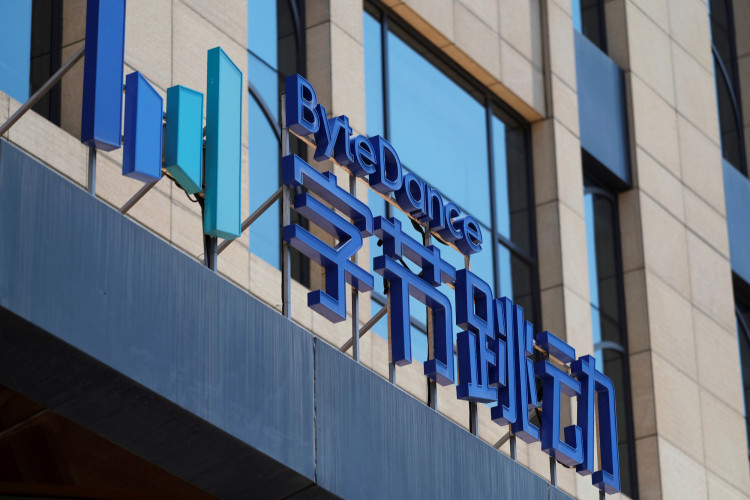
ByteDance is preparing to borrow a record $29.6 billion from a group of global banks after demand for the financing exceeded $30 billion, giving the TikTok parent a large pool of offshore capital as it accelerates spending on artificial intelligence infrastructure while remaining one of the world's biggest privately held technology companies.
The Beijing-based company initially sought about $20 billion but increased the syndicated loan after lender commitments reached roughly 1.5 times that amount. The transaction, which hasn't yet been formally signed as banks finalize allocations, carries an opening margin of 68 basis points over the Secured Overnight Financing Rate, or SOFR.
That pricing is notably tighter than ByteDance's previous offshore financing. In September 2024, the company raised $10.8 billion at 85 basis points over SOFR, meaning lenders are now accepting a 17-basis-point narrower margin even as ByteDance seeks almost three times as much money.
Citigroup and JPMorgan are coordinating the latest financing, as they did the 2024 transaction. Roughly 20 global banks participated in the earlier facility, which at the time was the largest dollar-denominated corporate loan in Asia outside Japan.
ByteDance's borrowing has expanded rapidly alongside its businesses. The company entered the offshore syndicated-loan market with roughly $1.335 billion in financing in 2019, followed by a $5 billion two-tranche transaction in 2021 and the $10.8 billion facility three years later.
The latest deal represents another step change. Its scale is particularly striking because syndicated lending in major currencies across Asia-Pacific excluding Japan fell about 15% from a year earlier during the first half of 2026, reaching a 16-year low.
SoftBank has been the notable exception, signing a $40 billion bridge facility in March to support its OpenAI investment. The financing structures are different: SoftBank's bridge loan supports an equity investment, while ByteDance is borrowing against the financial capacity of operating businesses that include TikTok's global advertising operations and Douyin's Chinese commerce ecosystem.
ByteDance's ability to attract more than $30 billion in bank commitments suggests lenders remain comfortable with its capacity to service substantial debt. Syndicated lending of this size typically requires participating banks to receive extensive financial information and negotiate contractual protections around the borrower's leverage and ability to meet its obligations.
That creates an unusual information divide around ByteDance. As a private company, it doesn't publish the detailed audited financial statements that a publicly traded technology company would routinely disclose to investors, even as banks financing its expansion receive information needed to assess its financial position.
Debt financing also allows ByteDance to raise capital without issuing additional equity or undertaking an initial public offering. An IPO would subject the company to substantially broader financial disclosure requirements while potentially diluting existing shareholders and exposing its valuation to public-market volatility.
The offshore dollar structure also matches part of ByteDance's spending needs. The company's AI expansion requires data centers, computing capacity, advanced memory and processors whose global supply chains are heavily dollar-based.
ByteDance has increased its planned 2026 AI capital expenditure to more than 200 billion yuan, or approximately $29.8 billion, according to the supplied reports. That represents an increase of at least 25% from an earlier plan prepared in 2025.
Part of the increase reflects rising costs for high-bandwidth memory, or HBM, an increasingly critical component in large AI computing clusters. Supply is concentrated among SK Hynix, Samsung and Micron, while advanced packaging capacity has also emerged as a constraint as technology companies race to expand AI infrastructure.
ByteDance's spending ambitions, however, face a problem that additional financing alone can't eliminate: access to advanced semiconductors.
U.S. export controls continue to restrict Chinese companies from obtaining Nvidia's most advanced processors. Although Washington approved Nvidia's H200 for export to China in December 2025, Chinese authorities have subjected purchases to case-by-case review.
As of late August, ByteDance had received about 10,000 H200 processors against a licensed ceiling of 75,000, according to the supplied report. That represents roughly 13% of the authorized amount, leaving the company with less access to Nvidia hardware than its nominal allocation would suggest.
ByteDance has consequently increased its reliance on Chinese semiconductor suppliers. Its 2026 purchases of Huawei Ascend 910B processors are estimated at more than 40 billion yuan, or roughly $5.95 billion, as the company attempts to diversify its computing infrastructure away from hardware exposed to U.S. export restrictions.
The company is also reported to be developing its own processor through an internal chip-design effort, with the goal of approaching Nvidia H200-level performance at a lower cost. That claim hasn't been independently confirmed, and ByteDance hasn't publicly provided detailed performance benchmarks for the processor.
The same transparency limitations apply to some of ByteDance's most ambitious AI projects. The company is reportedly training a large language model with 10 trillion parameters, but detailed information about its architecture, including the number of parameters activated during inference, hasn't been publicly disclosed or independently verified.
ByteDance is therefore pursuing an AI infrastructure strategy under conditions markedly different from those facing Amazon, Alphabet, Meta and Microsoft. The U.S. technology companies can acquire Nvidia's newest Blackwell-generation processors without the export restrictions confronting Chinese buyers, while collectively committing hundreds of billions of dollars to capital projects heavily weighted toward AI infrastructure.
ByteDance's regulatory position in the U.S. has also changed since its previous offshore financing. TikTok's U.S. operations were transferred in January 2026 into the TikTok US Data Security joint-venture structure, with ByteDance retaining a 19.9% stake alongside investors including Oracle, Silver Lake and Abu Dhabi-owned MGX.
The tighter margin on ByteDance's new loan suggests participating banks view its overall credit profile more favorably than when it arranged its 2024 facility, although loan pricing alone doesn't establish how lenders assess any individual regulatory or geopolitical risk.
ByteDance also continues to operate under Chinese law, including the country's National Intelligence Law, Cybersecurity Law and Data Security Law. Those statutes impose various cooperation, security and data-related obligations on Chinese organizations, an issue that has long contributed to scrutiny of ByteDance in the U.S. and other markets.
The TikTok U.S. structure addresses regulatory concerns surrounding American TikTok operations but doesn't remove ByteDance's Chinese businesses or global AI development activities from the legal framework governing companies headquartered in China. At the same time, the supplied material identifies no publicly documented instance establishing that Chinese authorities accessed user data from ByteDance's AI products.