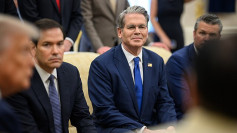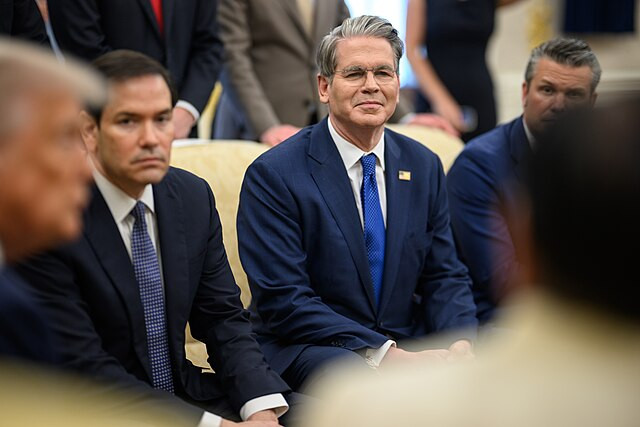
Treasury Secretary Scott Bessent said the U.S. can't afford to lose its artificial-intelligence advantage over China, sharpening the Trump administration's argument for rapid AI development just as lawmakers, state governments and researchers are pushing for tighter restrictions on the technology and the infrastructure powering it.
"Beating China - there is no day after tomorrow if China wins at this," Bessent said during a Breitbart News event. "Like everything, a trillion-and-a-half-dollar defense budget, the Iron Dome. If they were to pull ahead of us on AI, then nothing else matters."
Bessent said the U.S. currently holds the lead, but his remarks underscored how Washington increasingly views AI development through the lens of strategic competition with Beijing. The administration has generally favored accelerating investment in computing infrastructure while resisting regulations it says could slow American companies relative to Chinese competitors.
That approach is colliding with growing resistance to the physical footprint of AI. Data centers require large amounts of electricity and, depending on their cooling systems, water, prompting communities and state officials to scrutinize their effects on utility bills, power-grid reliability and local infrastructure.
Pennsylvania Gov. Josh Shapiro imposed some of the country's more stringent state-level requirements in August. His executive order requires data-center developers seeking state permits to make legally binding commitments covering energy affordability, environmental protections, workforce development, transparency and community engagement and to secure local approval before the state Department of Environmental Protection reviews their applications.
The order also removed data centers from Pennsylvania's fast-track permitting program. Developers must report information about electricity and water consumption, while state officials are directed to pursue mechanisms designed to prevent the cost of new power infrastructure from being shifted to households and other businesses.
The resistance isn't limited to data-center construction. Sen. Bernie Sanders, an independent from Vermont, and Rep. Greg Casar, a Texas Democrat, announced proposed legislation last week that would permanently prohibit the development and deployment of artificial superintelligence and temporarily pause certain advanced AI development until a federal regulator establishes safety requirements.
"If the leaders of the major AI companies acknowledge that they are losing control of their extremely dangerous technology, it is irresponsible for society to allow them to move forward and make these products even more advanced," Sanders said, according to the source article.
The political debate has gained urgency from warnings emerging from inside the companies building advanced AI systems. Jacob Coxon, an Anthropic researcher who previously worked at OpenAI, resigned this week while arguing that competition among leading laboratories is pushing development forward faster than safety mechanisms can keep pace.
"People building AI earnestly believe that it could kill us all by the end of the decade," Coxon wrote, according to the source article.
Evan Hubinger, who leads alignment-science research at Anthropic, publicly supported the substance of Coxon's warning. "I personally think it is >10% within the next decade. I believe Anthropic is trying its best, but we do not yet have a plan to solve alignment for superintelligence and are not clearly on track to," Hubinger wrote, according to the source article. His estimate represents his assessment of risk, not a measurable forecast or scientific consensus.
The competing arguments expose a policy dilemma that is becoming harder for Washington to avoid. Slowing development could, advocates of rapid deployment argue, give Chinese laboratories an opening to narrow the U.S. lead. Moving too quickly, critics counter, could allow increasingly capable systems to be deployed before governments and developers understand how to control them.
The geopolitical competition is intensifying at the same time. U.S. authorities this week accused several Chinese AI companies, including DeepSeek, Moonshot AI and Alibaba, of using American models in large-scale distillation efforts to accelerate development of their own systems. China rejected the allegations and said its advances stem from domestic innovation.
Washington and Beijing are nevertheless preparing for their first official bilateral talks focused specifically on AI safety, tentatively scheduled for mid-September. Bessent is expected to lead the U.S. side, while China's delegation could be headed by Vice Premier He Lifeng or senior Communist Party official Ding Xuexiang, though the participants and final agenda remain under discussion.
The discussions are expected to address risks from increasingly capable AI systems, including the potential use of autonomous systems in cyberattacks, while exploring mechanisms for information sharing between American and Chinese AI laboratories. They are being prepared ahead of a planned meeting between President Trump and Chinese President Xi Jinping later this month.