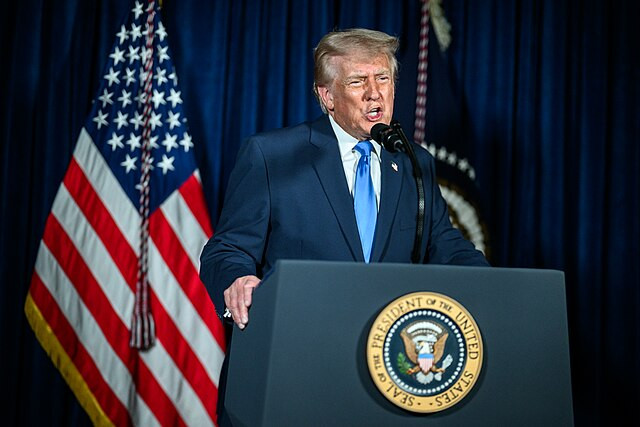
President Donald Trump renewed a threat to strike Iran's deeply buried Pickaxe Mountain facility after satellite imagery showed an acceleration of construction at the nuclear-linked site near Natanz, adding another potential flashpoint to the continuing U.S.-Iran war as international scrutiny of Tehran's nuclear program intensifies.
"We notice there's a little activity at Pickaxe. I would advise Iran not to get cute because we will have to hit them very hard," Trump said Wednesday during the Republican midterm convention in Dallas. Reuters confirmed the remarks and reported that the U.S. has so far left the fortified tunnel complex untouched.
Trump's warning followed a new analysis from the Center for Strategic and International Studies, which examined multisource satellite imagery of Pickaxe Mountain and found more construction activity in 2026 than at any previous point in the facility's development. The site consists of underground tunnels near Iran's heavily damaged Natanz uranium-enrichment complex.
CSIS researchers Joseph Rodgers, Douglas Comstock and Joseph S. Bermudez Jr. said the imagery shows a "clear three-phase activity signature across the five key points of interest and the roads connecting them, indicating a site that has shifted from active excavation toward probable internal construction and continued exterior reinforcement."
The changes include what the researchers described as a "hardening of the portal accesses, paving of the internal road network, reinforcement around access areas, and the flattening and removal of excavation spoil." CSIS said construction accelerated beginning around October 2025, when imagery also showed Iran erecting a security perimeter around the facility.
What is happening inside the mountain remains less certain. Israeli intelligence believes Iran moved thousands of uranium-enrichment centrifuges and centrifuge components into the tunnels last fall, Israeli and U.S. officials told The Wall Street Journal in July. The assessment heightened concern that Iran could use the protected complex to rebuild parts of its enrichment program damaged elsewhere.
The publicly available imagery doesn't establish that enrichment is occurring at Pickaxe Mountain, however. CSIS said its analysis could neither confirm nor refute the Israeli intelligence assessment and cautioned that the evidence available so far "suggest the underground facility is not yet capable of enrichment work, if that is the intended purpose."
"Further analysis of daily activity would be needed to establish the site's pattern of life beyond its current construction footprint," the CSIS report said.
The distinction is significant because Pickaxe Mountain has long attracted attention precisely because of its depth and potential nuclear role. International Atomic Energy Agency Director General Rafael Grossi has said Iran informed the agency in 2021 that it intended to conduct nuclear activity at the mountain, while Iran maintains that its nuclear program is intended for peaceful purposes.
Pickaxe has also survived the broader military campaign without being directly attacked. The U.S. and Israel have heavily damaged the nearby Natanz enrichment facility, but Reuters reported Thursday that neither of Pickaxe Mountain's deeply buried tunnel complexes has been struck.
Trump has been publicly considering an attack on the site since at least July. The Wall Street Journal reported then that administration officials were examining options including bombing Pickaxe Mountain as Trump considered expanding U.S. military operations against Iran.
"We're going to take out Pickaxe Mountain," Trump told radio host Hugh Hewitt in July, according to The Wall Street Journal. The president later offered a more conditional formulation, saying that if Iran made a move toward turning the facility into an operating nuclear site, "we immediately go and do whatever we have to do, but they haven't."
The facility presents an unusually difficult military target. The Wall Street Journal reported that the tunnels are believed to lie roughly 300 to 475 feet beneath the mountain, substantially deeper than Iran's Fordow and Natanz enrichment sites. Publicly available imagery also hasn't revealed obvious ventilation shafts comparable with those targeted during earlier U.S. strikes on Fordow.
The renewed focus on Pickaxe coincides with increased diplomatic pressure on Iran over unresolved questions about its nuclear history. On Wednesday, the International Atomic Energy Agency's 35-member Board of Governors reported Iran to the U.N. Security Council for the first time in 20 years over Tehran's failure to cooperate with a long-running investigation into uranium traces found at undeclared locations.
Twenty-three countries supported the resolution, according to the Associated Press. China, Russia and Niger voted against it, eight countries abstained, and one member couldn't vote because it was in arrears.
Western officials have said the unexplained uranium traces could provide evidence of nuclear-weapons-related activities that Iran conducted before 2003. Iran rejects allegations that it pursued a secret weapons program and says its nuclear activities are peaceful; Tehran has also argued that the continuing war has prevented it from guaranteeing inspectors safe access to nuclear facilities.