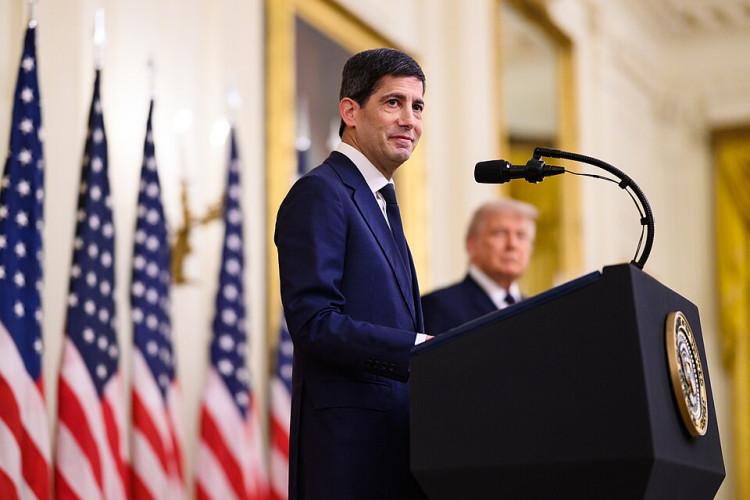
Federal Reserve Chair Kevin Warsh delivered a hawkish message Wednesday after the central bank raised interest rates for the first time in three years, warning that recent inflation data haven't provided convincing evidence that underlying price pressures are easing and leaving the door open to another increase this year.
The Federal Open Market Committee unanimously raised its benchmark federal-funds rate by a quarter percentage point to a range of 3.75% to 4%, reversing direction after a period of easier monetary policy. Updated projections showed the median Fed official expects the rate to reach 4.1% by the end of 2026, implying another quarter-point increase.
At his post-meeting news conference, Warsh made clear that inflation rather than weakness in the labor market is driving the Fed's immediate policy stance.
"The plain fact is that inflation is too high, and has been for too long," Warsh said, adding that the FOMC's "predominant focus is on the price stability side of our mandate."
"This summer's inflation readings do not tell me that underlying trends have meaningfully improved," Warsh said. Several measures of price growth remain above 3% when examined over six- and 12-month periods, reinforcing the Fed's concern that inflation could remain persistent rather than quickly retreat toward its target.
The Fed's formal statement reinforced that message, saying "inflation remains elevated" and that Wednesday's increase "will support a timelier return to the Committee's 2 percent goal." Policymakers added an unusually direct commitment: "The Committee will deliver price stability."
The increase was approved on a 12-0 vote, indicating broad agreement among policymakers despite debate in recent weeks over whether the inflation shock warranted immediate tightening. The Fed will raise the interest rate paid on reserve balances to 3.90% and its primary credit rate to 4%, effective Thursday.
The new economic projections underscore the Fed's concern. Officials now expect headline personal-consumption-expenditures inflation to end 2026 at 3.7%, slightly above their 3.6% June projection. Core PCE inflation is projected at 3.4%, compared with 3.3% in June.
Policymakers nevertheless aren't forecasting a major economic downturn. The FOMC said "economic activity is expanding at a solid pace," while domestic spending has remained resilient despite heightened uncertainty associated in part with geopolitical developments.
"Productivity growth is strong, and capital investment is robust. Job gains have kept pace with the workforce, and the unemployment rate has changed little," the committee said. The median Fed projection puts the unemployment rate at 4.1% at the end of 2026, down from the 4.3% forecast in June.
That combination-a resilient economy alongside inflation well above target-gives the Fed more room to tighten policy than it would have if employment were deteriorating sharply. It also helps explain why Warsh's comments focused heavily on inflation persistence rather than signaling that Wednesday's increase could be a one-time adjustment.
Financial markets reacted quickly to the tougher message. Stocks turned lower during Warsh's press conference as investors reassessed how long borrowing costs could remain elevated, while bond markets also responded to the prospect of additional tightening.
The shift had been building for weeks. At the Jackson Hole economic symposium in August, Warsh warned that the Fed would "have work to do" if officials couldn't gain confidence that inflation was moving sustainably toward 2%, bringing the possibility of rate increases explicitly into the policy debate.
Market participants had also become substantially more hawkish before Wednesday's decision. A CNBC survey of economists, fund managers and strategists found that 86% expected at least one rate increase in 2027 and 55% anticipated more than one, compared with 46% expecting a future hike in the previous survey.
Energy prices remain an important source of uncertainty. Survey respondents broadly expected disruption around the Strait of Hormuz to persist for at least another month, with roughly three-quarters anticipating that higher energy costs would eventually spread into broader consumer prices.
The Fed's projections nevertheless show officials expect inflation to fall significantly next year. Median forecasts put headline PCE inflation at 2.3% in 2027 and 2.1% in 2028, while core inflation is projected at 2.5% and 2.2%, respectively.
But policymakers simultaneously raised their projected interest-rate path. The median estimate now puts the federal-funds rate at 4.1% at the end of both 2026 and 2027, compared with June forecasts of 3.8% and 3.6%, respectively.