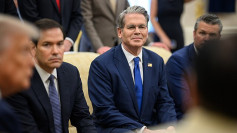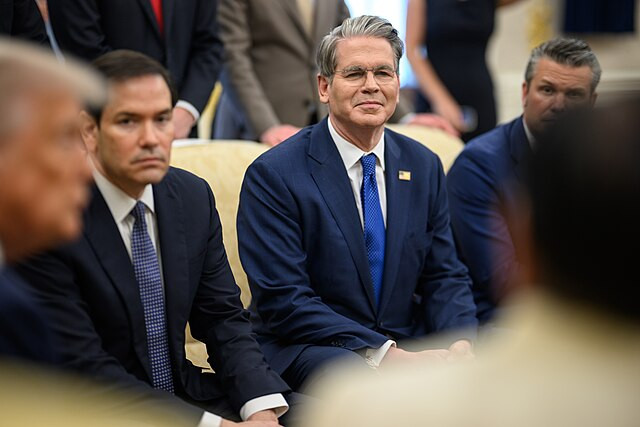
Treasury Secretary Scott Bessent said the U.S. and China discussed creating a system to alert each other when artificial-intelligence incidents rise to the level of a national-security threat, opening a new channel for cooperation between the world's two leading AI powers days before President Donald Trump and Chinese President Xi Jinping meet in Washington.
Bessent described Sunday's talks in New York with Chinese Vice Premier He Lifeng as "very successful." U.S. Trade Representative Jamieson Greer also participated in the roughly eight-hour meeting, which was intended to lay groundwork for Thursday's Trump-Xi summit and covered trade as well as artificial intelligence.
The U.S. proposed what Bessent called a "notification mechanism" that could be activated when an AI-related incident reaches the national-security level. The broader framework, described as a U.S.-China AI dialogue, would give officials a channel to discuss shared threats and other concerns surrounding increasingly powerful AI systems.
"We want a shared vision of common goals and common threats," Bessent told reporters after the meeting. "We think that just like any cross-border activity, that moving from opaque to more transparency between the No. 1 and the No. 2 AI powers in the world is very important."
The proposal represents a narrow area of potential cooperation within a broader technological rivalry. Washington continues to restrict Chinese access to some advanced semiconductors and chip-manufacturing equipment, while both governments view leadership in AI as strategically important. Greer said those export controls weren't part of the proposed notification mechanism.
Chinese state media described the economic discussions as "frank, in-depth, and constructive" and said the two sides exchanged views on AI-related issues. The countries are expected to continue the discussions, but neither side announced a finalized AI agreement Sunday.
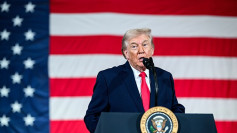
The talks come as Washington confronts competing pressures over how quickly AI should advance. Trump has opposed calls to slow development on safety grounds, arguing that allowing U.S. companies to lose momentum could help China close the technological gap. At the same time, researchers and technology executives have pressed policymakers to prepare for potentially serious risks from increasingly capable systems.
Those concerns were underscored last week by Geoffrey Hinton, the Nobel laureate and computer scientist often called the "Godfather of AI." After a closed-door briefing with lawmakers, Hinton warned that Congress may have little time left to establish effective safeguards.
"Maybe a year, but not much more than a year," Hinton said when asked how much time lawmakers had to act. Because the gathering was a closed briefing rather than a public hearing, there is no official transcript of his remarks; accounts are based on comments made afterward.
Hinton said expectations for the arrival of AI systems exceeding human capabilities have shortened substantially. "It used to be maybe 30 years, maybe 50 years. Then it came down to maybe 10 years, maybe 20 years. Now people are saying, a lot of the researchers are saying only a few years," he told reporters.
The U.S.-China proposal doesn't amount to an agreement to slow AI development or establish joint regulation. Instead, it resembles a crisis-communication mechanism designed to give the two governments a way to notify each other when an AI incident creates sufficiently serious security implications.
Potential concerns extend beyond malfunctioning AI models. Researchers and policymakers have focused on the possibility of advanced systems being used in cyberattacks, biological threats and attacks on critical infrastructure, as well as longer-term concerns about losing effective control over increasingly autonomous systems.
AI wasn't the only issue on the table Sunday. Bessent and Greer said Washington and Beijing were also moving forward with a "Board of Trade" discussed when Trump and Xi met in Beijing in May. Officials are examining categories of nonsensitive goods that could qualify for lower tariffs, potentially including consumer products, agriculture, energy and medical devices.
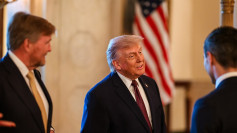
Trump is scheduled to host Xi at the White House on Thursday, their second face-to-face meeting this year after talks in Beijing in May. AI, trade and critical minerals are expected to figure prominently in the discussions, with the proposed notification system offering one potential area where strategic competitors could establish a channel for managing risks without resolving their broader technological rivalry.